
One of the most common mistakes divorced men make when they start dating again is comparing every new woman to their ex-wife. It may feel natural, but if you do it constantly, it can quietly sabotage your dating life.
After divorce, your ex-wife can become the reference point for almost everything. You may compare how a new woman talks, dresses, laughs, listens, handles money, shows affection, parents her children, manages stress, or responds to conflict. Sometimes the comparison is positive. Sometimes it is negative. Either way, the new woman is no longer being seen clearly.
Instead of discovering who she is, you are measuring her against someone from your past. That past may include real memories, painful wounds, idealized moments, disappointments, regrets, and unfinished emotions. When all of that becomes the filter, healthy dating after divorce becomes much harder.
Comparison does not always mean you want your ex-wife back. It often means your former marriage still occupies too much mental space. You may be trying to protect yourself from repeating the same mistake. You may be searching for something familiar. You may be trying to prove that the next woman is better. But a healthy future cannot be built by constantly checking it against an old relationship.
Why Divorced Men Compare New Women To Their Ex-Wives
Comparison is a normal human habit. Your brain uses past experience to evaluate new situations. If your marriage was the longest or most serious relationship of your adult life, it makes sense that your mind would reach for that relationship as a reference point.
The problem begins when the comparison becomes automatic. A new woman says something and you think, “My ex would never say that.” She reacts to stress and you think, “My ex handled this better.” She shows affection differently and you think, “This does not feel like what I am used to.”
At that point, you are no longer simply learning from the past. You are living through it. Every new interaction gets processed through old emotional material.

Your ex-wife may represent comfort, pain, disappointment, loss, or familiarity. Even if the marriage ended badly, familiar patterns can still feel easier to understand than new ones. That is why some men unconsciously search for a woman who feels similar, while others reject anyone who reminds them of their ex in any way.
Both reactions are still controlled by the past. The goal is not to find the opposite of your ex-wife. The goal is to find someone compatible with the man you are now.
The Hidden Problem With Comparison
Most men think comparison helps them make better decisions. Sometimes it can. Your previous marriage should teach you what you value, what you ignored, what you tolerated too long, and what you want to avoid. That is wisdom.
But constant comparison creates distortion. Your memory may not be as accurate as you think. After divorce, many men remember the marriage in extremes. Some romanticize the good parts and forget the reasons the relationship failed. Others focus only on the bad parts and forget that the relationship had strengths too.
Either way, the benchmark becomes unfair. You are not comparing one real person to another real person. You are comparing a real woman in front of you to a selected memory of your ex-wife.
This is why the comparison trap is so damaging. A new woman has to live in real time. She has ordinary flaws, ordinary habits, and ordinary differences. Your ex-wife, in your mind, may become either the perfect warning sign or the perfect lost standard. Neither version is fully real.
The Effects Of Constant Comparison
Comparing new women to your ex-wife can affect your emotional readiness, your dating judgment, and the quality of your future relationships. It can keep you mentally attached to the past while convincing you that you are moving forward.
The first effect is emotional unavailability. If you are constantly thinking about how a new woman compares to your ex, you are not fully present. You may be sitting across from someone new, but emotionally you are still in conversation with your former marriage.
The second effect is unfair judgment. A new woman may have strengths your ex-wife did not have, but you may miss them because you are focused on what feels different. She may communicate with more maturity, have stronger values, or offer more peace, but if she does not match the old template, you may undervalue her.

The third effect is pressure. Most women can feel when they are being measured against someone else. Even if you do not mention your ex-wife directly, the comparison can show up in your reactions, questions, expectations, and disappointments.
The fourth effect is self-sabotage. You may end good connections too early because they do not feel familiar. Or you may choose familiar women who recreate the same old problems. Either way, the past keeps influencing the future more than it should.
Every Woman Is A Different Story
One of the most important mindset shifts after divorce is simple: every woman is a different story. She is not the sequel to your marriage. She is not a replacement for your ex-wife. She is not a correction of your past. She is a separate person with her own history, strengths, weaknesses, values, fears, habits, and hopes.
If you treat dating like an audition for the role your ex-wife used to play, you will struggle to connect honestly. You may look for similarities that do not matter. You may overreact to differences that are not actually problems. You may expect a new woman to understand wounds she did not create.
A healthier approach is curiosity. Instead of asking, “Is she better than my ex-wife?” ask, “Who is this woman? What is her character? How does she handle life? Do we communicate well? Do our values align? Do I feel peace, attraction, respect, and honesty around her?”
Compatibility Is More Important Than Comparison
Many men confuse strengths with compatibility. Your ex-wife may have been more outgoing, more organized, more affectionate, more ambitious, or more financially disciplined in certain ways. But individual strengths do not automatically equal a healthy partnership.
Compatibility is about how two lives work together. It includes trust, emotional maturity, communication, shared values, mutual respect, conflict resolution, lifestyle alignment, and willingness to grow. A woman can be different from your ex-wife and still be a much better match for you.
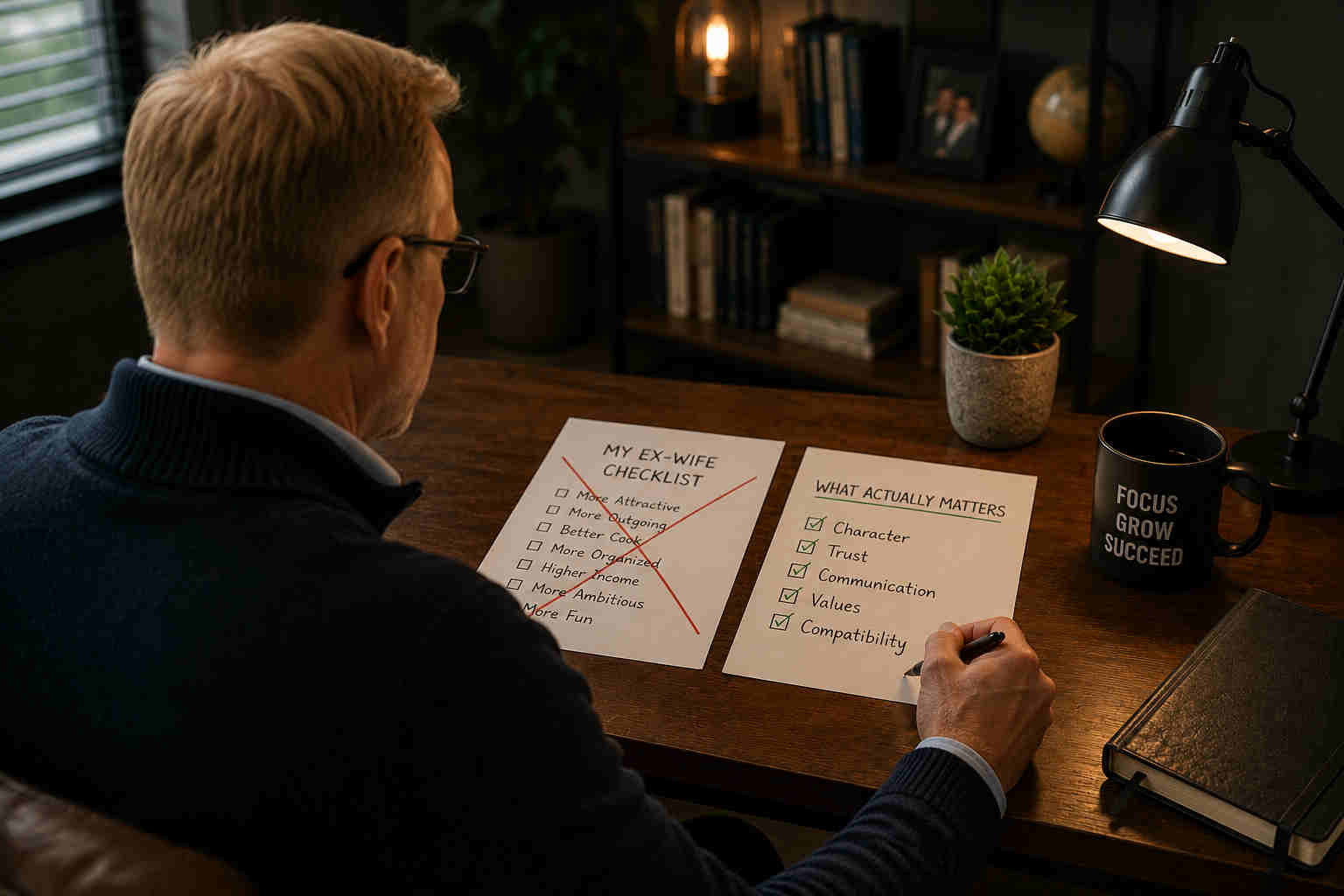
When you focus on comparison, you ask the wrong questions. “Is she as attractive as my ex?” “Is she as fun?” “Is she as successful?” “Does she remind me of what I had?” These questions keep you circling the old relationship.
Better questions are more useful. “Does she respect boundaries?” “Can we talk through disagreement?” “Do I feel calm and clear around her?” “Does she bring honesty and consistency?” “Are we building something that fits who I am now?”
Why Some Men Compare Because They Have Not Fully Let Go
Comparison sometimes reveals unfinished grief. That does not mean you want your ex-wife back. It may mean you have not fully processed the marriage, the loss, the disappointment, or the identity shift that came with divorce.
You may still be grieving the version of life you expected to have. You may miss the family structure, the routine, the familiar home life, the holidays, or the idea of being a husband. A new woman may trigger those memories without meaning to.
This is why emotional healing after divorce matters. If your former marriage is still emotionally active inside you, new relationships can become confusing. You may compare because part of you is still trying to understand what happened, what was lost, and what should come next.
Letting go does not mean pretending your marriage never mattered. It means allowing it to become a chapter instead of the entire story.
How To Stop Comparing New Women To Your Ex-Wife
The first step is noticing the comparison in real time. When you catch yourself thinking, “My ex was better at this,” or “My ex never did that,” pause before accepting the thought as truth. Ask yourself whether the comparison is actually helpful or whether it is pulling you back into an old emotional pattern.
The second step is to name what really matters. If you are comparing a new woman’s personality, ask whether the issue is truly compatibility or just unfamiliarity. If you are comparing her appearance, ask whether attraction is present without needing her to match an old image. If you are comparing her communication style, ask whether the communication is healthy, not whether it is familiar.
The third step is to give new connections time. Early dating is not enough to know everything. Some strengths reveal themselves slowly. Patience gives you a better chance to evaluate character instead of reacting to surface-level differences.
The fourth step is to stop using your ex-wife as the default standard. She can teach you lessons, but she should not define every future choice.
Building A New Standard Instead Of Using An Old One
After divorce, you need a new relationship standard. That standard should not be based on copying your ex-wife or avoiding every trait she had. It should be based on your values, your future, your growth, and the kind of partnership you want to build now.
Write down what actually matters to you. Character. Honesty. Emotional availability. Mutual respect. Communication. Shared values. Peace. Attraction. Accountability. Compatibility. These qualities are more useful than a checklist built around your former marriage.
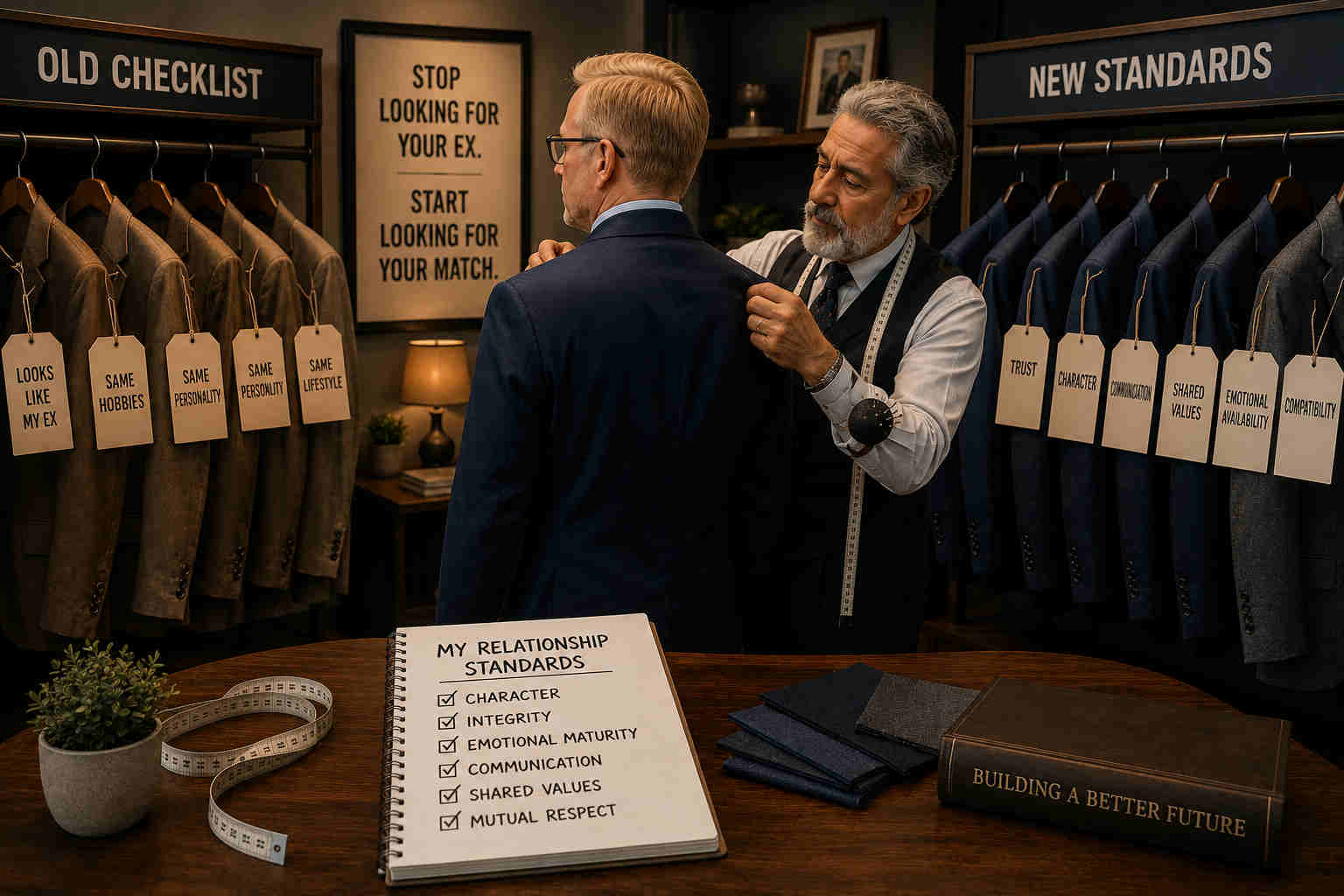
A new standard helps you date with clarity. It gives you something healthier to measure by. Instead of asking whether she is like your ex-wife, you ask whether the relationship supports the man you are becoming.
This is where dating after divorce becomes more mature. You are not trying to win, replace, prove, or recreate. You are choosing carefully.
What Healthy Dating After Divorce Looks Like
Healthy dating after divorce is calmer than many men expect. It does not require constant emotional intensity. It does not require someone to erase your past. It does not require a woman to match the old life you once had.
Healthy dating allows room for differences. It gives you space to learn someone slowly. It lets attraction grow with trust. It values peace as much as excitement. It allows you to say, “She is different, and that may be good.”
A healthy mindset sounds like this: “My past taught me, but it does not control me.” “I can appreciate what was good without trying to recreate it.” “I can recognize red flags without punishing someone new for someone else’s mistakes.” “I want compatibility, not familiarity.”
When you reach that point, dating becomes less about comparison and more about discovery.
Questions To Ask Yourself
The next time you catch yourself comparing a new woman to your ex-wife, ask yourself a few honest questions. Am I remembering the full marriage or only selected parts? Am I comparing strengths or compatibility? Would I want a woman constantly comparing me to her ex-husband? Am I being fair to the person in front of me?
Also ask whether the comparison is protecting you or trapping you. Sometimes comparison helps you notice a real issue. Other times it becomes a way to avoid vulnerability. If every woman falls short, the issue may not be the women. The issue may be the standard you are using.
The goal is not to ignore your experience. The goal is to use your experience wisely without allowing it to dominate your future.
Final Thoughts
Comparing new women to your ex-wife is understandable. Your marriage shaped you. It taught you lessons. It left memories. It may have left pain. But if you keep using that marriage as the measuring stick for every new relationship, you will struggle to see clearly.
Every woman is her own story. Every relationship is its own experience. The healthiest path forward is not finding someone who resembles your ex-wife or someone who is the complete opposite. The healthiest path is becoming clear about who you are now and what kind of relationship actually fits your future.
The goal is not to recreate the past. The goal is to build something wiser, healthier, calmer, and more fulfilling than what you left behind.
Keep Building Dating Readiness
This article is part of the Dating Readiness section for divorced men who want to date again with clarity, confidence, and stronger relationship judgment.
Back To Dating Readiness