
International Dating Safety For Divorced Men
What To Do If an Overseas Meeting Feels Wrong—and Its Effects
The most important question is not whether you can prove that something is wrong. It is whether you feel comfortable continuing.
You have spent months talking. There were video calls, messages before work, long conversations across time zones, photographs from ordinary days, and plans that slowly became more serious. Eventually, you bought the ticket, crossed an ocean, checked into a hotel, and prepared to meet the woman who had occupied so much of your attention.
Then you meet her in person, and something feels wrong.
There may be no dramatic confrontation. She may look like her photographs. She may be polite. She may even appear pleased to see you. Yet the warmth from your online relationship seems absent. Her behavior changes when other people arrive. She avoids simple questions. Money suddenly enters the conversation. A relative appears with an emergency. You are pressured to change hotels, travel somewhere isolated, make a financial commitment, or prove your love.
Sometimes you cannot identify one decisive red flag. You simply feel uneasy. For a divorced man meeting someone overseas for the first time, that feeling can produce a painful internal conflict. You have invested time, money, hope, and pride. You want the relationship to be real. That is exactly when judgment is most vulnerable.
Why the First Meeting Can Feel Different From the Online Relationship
Most people picture international dating danger as something obvious: a stolen wallet, a threatening stranger, a fake identity, or an aggressive demand for money. In reality, many troubling first meetings begin with something quieter—inconsistency.
Online, she was affectionate and curious about your life. In person, she is distracted or impatient. Online, she said money did not matter. During the visit, expensive shopping, bills, and family needs dominate the conversation. Online, she wanted to move slowly. In person, she wants an immediate engagement or financial promise.
One awkward moment does not prove deception. Jet lag, shyness, language barriers, nerves, and cultural differences can all affect a first meeting. The concern is a pattern in which reality repeatedly contradicts the relationship you were shown online.

The Most Dangerous Thought: “I Came All This Way”
One of the strongest forces keeping men in uncomfortable overseas situations is the sunk-cost effect. You bought the airline ticket, reserved the hotel, took time away from work, told people about the relationship, and traveled farther than you may ever have traveled before.
Walking away can feel like admitting the entire journey was a mistake. So you bargain with yourself: perhaps you should give it another day, perhaps you misunderstood, or perhaps you are being unfair. Those possibilities may deserve calm consideration, but the money and time already spent should not determine what you do next.
The better question is: Given what I know now, what decision would I make if I had nothing to prove? Your airfare has already been spent whether you stay with her or not. The goal is no longer to make the trip justify itself. The goal is to make the next sound decision.
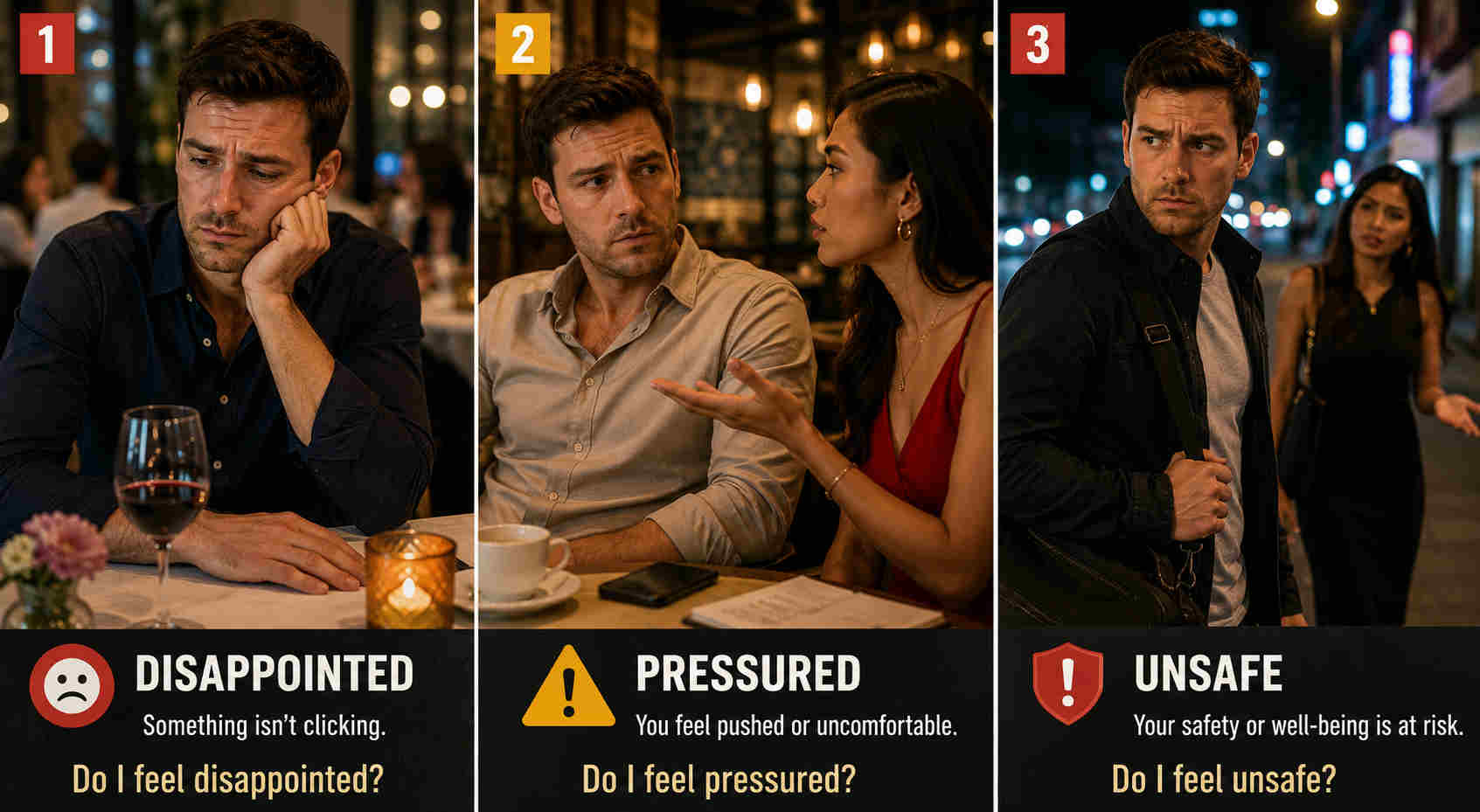
Separate Disappointment From Pressure and Danger
Not every disappointing overseas meeting is unsafe. The chemistry may simply be weaker than expected. She may be quieter in person, the conversation may feel forced, or your personalities may not fit. That hurts, but it is not automatically a safety problem.
A more concerning situation includes pressure, secrecy, manipulation, isolation, rapidly changing stories, intimidation, or attempts to separate you from your passport, phone, money, hotel, or transportation.
Ask yourself three direct questions: Am I disappointed? Am I being pressured? Do I feel unsafe? Disappointment may call for an honest conversation. Pressure calls for firmer boundaries. Feeling unsafe calls for leaving. You do not have to wait for the situation to deteriorate before acting on what is already happening.

Your Body May Notice the Problem Before Your Mind Explains It
The brain constantly processes tone of voice, facial expressions, physical distance, contradictions, environmental changes, and unusual behavior. Sometimes you feel the conclusion before you can clearly describe the evidence.
Your stomach tightens. You become unusually alert. You keep checking the exit. You do not want to enter a particular vehicle, drink what has been handed to you, leave a public place, or become isolated with someone. These reactions do not prove criminal intent, and travel stress can create anxiety. But you do not need courtroom evidence to protect yourself.
If you do not want to get into the car, do not get in. If you are uncomfortable leaving the restaurant, remain in the public area. If being alone with someone suddenly feels wrong, return to your hotel. You can analyze the situation later from somewhere secure.

The Cultural Difference Trap
Cross-cultural relationships involve real differences in family roles, punctuality, affection, gender expectations, money, privacy, religion, and communication. Yet culture should never become a universal excuse for behavior that violates your boundaries.
A cultural difference may explain why her family wants to meet you early. It does not require you to give them money. It may explain traditional dating expectations. It does not require you to surrender control of your finances. It may explain why marriage is discussed sooner than you expected. It does not require you to become engaged before you are ready.
A healthy cross-cultural relationship permits questions and disagreement. You should be able to say no, slow the relationship down, keep your own hotel, and retain control of your documents, transportation, and money. When every concern is dismissed with “you do not understand my culture,” pay attention.

What To Do the Moment an Overseas Date Feels Wrong
Your first response should not be an accusation. It should be to preserve your independence. Keep your passport with you or secured somewhere only you control. Keep your phone charged and accessible. Maintain separate access to money. Know the name and address of your hotel, and keep an independent way to return there.
You do not have to announce that you believe someone is deceiving you. A direct accusation can escalate a tense situation. You can simply say, “I am not feeling well, so I am returning to my hotel,” or “I need some time alone tonight.”
Avoid long explanations. When people feel uncomfortable, they often over-explain because they want permission to leave. Explanations create openings for negotiation. You do not need permission.

Never Let Someone Manufacture Urgency
The hospital bill must be paid tonight. A relative needs money immediately. The landlord is demanding payment. The business opportunity disappears tomorrow. The engagement must happen before you leave. The family needs proof of your commitment.
Urgency is powerful because it prevents reflection. When an unexpected emotional or financial crisis appears during your trip, do not make a major decision in the moment. Return to your hotel, sleep, call someone you trust, and verify the story independently.
A genuine emergency does not automatically become the financial obligation of a man who has just arrived in the country. If someone insists that hesitation proves you do not care, the pressure itself is valuable information.
Contact Someone Who Is Not Emotionally Invested
Months of anticipation make you anything but a neutral observer. Call a trusted friend or relative and describe the facts without defending the woman or exaggerating the danger. Instead of saying, “She needs help, but I know she is honest,” say, “On our second day together, she asked me for $3,000.”
Ask: If another man told you this story, what would you advise him to do? Emotional distance often makes the answer clearer. You are not surrendering your judgment; you are checking it against someone who is not influenced by attraction, travel expenses, or the fear of embarrassment.

The Boundary Test: What Happens After You Say No?
Suppose she asks for money and you decline. A healthy response may include disappointment or an honest discussion. A concerning response may include anger, guilt, threats, withdrawal of affection, claims that you do not love her, or accusations that a “real man” would pay.
Manipulative people often begin with small tests. Will you change hotels? Cancel your independent plans? Hand over your phone? Pay an unexpected bill? Hide the situation from your family? Accept behavior overseas that would make you leave immediately at home?
A boundary is not merely a statement. It is a decision you are prepared to enforce. Reasonable precautions do not declare someone guilty. You can refuse money, decline an isolated trip, or delay an engagement without labeling anyone a scammer. If a basic precaution destroys the relationship, that reaction is itself evidence about the relationship.
The Emotional Effects When an Overseas Meeting Goes Wrong
The impact can extend long after the trip. You may feel embarrassed, angry, or ashamed that you ignored warning signs. You may question whether loneliness after divorce made you too eager to believe. If money was lost, the psychological injury may feel worse than the financial loss because you are grieving both a person and a future you imagined.
Some men respond by becoming cynical about all women, international dating, or relationships generally. That reaction is understandable but costly. One failed meeting should not become a permanent verdict on your future.
The useful lesson is not “never trust again.” It is: trust gradually, verify independently, maintain your freedom, and act sooner when words and behavior stop matching. Wisdom does not require permanent suspicion. It requires better filters.
Why Divorce Can Make the Impact Stronger
After divorce, an overseas relationship may represent more than romance. It can symbolize proof that a new life is possible. Perhaps you spent years feeling ignored, rejected, criticized, or emotionally invisible. Then someone thousands of miles away seems excited to hear from you. You feel wanted again.
That experience is emotionally real even if the relationship later proves unhealthy. When the meeting fails, you are not only losing the woman. You may feel that you are losing the future she represented. Remember that the future you wanted—companionship, adventure, intimacy, and a meaningful relationship after divorce—is not owned by one person.

The 24-Hour Independence Test
Before making a major romantic or financial decision, spend 24 hours independently. Stay at your own hotel. Use your own transportation. Do not send money, make promises, become engaged, or give anyone control of your documents, finances, phone, or itinerary.
Then observe two things. First, notice how you feel with distance. Are you calmer? Is your thinking clearer? Do contradictions become easier to see? Second, observe how she responds. Does she respect your need for time, or does she bombard you with calls, guilt, anger, threats, and new emergencies?
Sometimes the clearest information appears when you temporarily stop cooperating with the momentum of the relationship.
Do Not Stay to Avoid Looking Foolish
You may have told friends, children, coworkers, or even your former spouse about the trip. Returning early can feel humiliating. You imagine questions about whether the woman was real or whether you were scammed.
But staying in an unsafe or manipulative situation to avoid embarrassment allows people who are not even present to influence your safety. You can simply say, “The meeting did not work out as I expected.” Changing your mind when new information appears is not failure. It is sound judgment.
If You Decide to Leave During the Trip
If you have safety concerns, do not end the relationship while isolated, inside someone else’s home, or dependent on that person for transportation. Return to your hotel or another secure public place first. If necessary, change hotels, ask staff for assistance, adjust your itinerary, and tell someone at home where you are going.
If you believe you are in immediate danger, contact local emergency services or the nearest U.S. embassy or consulate. Do not prioritize politeness over physical security. Explanations can come later.

Final Thoughts: You Are Allowed to Change Your Mind
You can fly 5,000 miles and change your mind. You can spend six months talking to someone and change your mind. You can buy a ring and decide not to propose. You can plan a two-week trip and leave after three days. You can believe someone is wonderful online and decide the in-person relationship does not feel right.
You do not owe a relationship continued access to you because of previous promises, expenses, or emotions. New information should influence new decisions. That is not inconsistency. That is judgment.
If an overseas meeting feels wrong, you do not have to immediately determine whether the other person is dishonest, dangerous, manipulative, or simply incompatible. You only need to choose your next safe action: slow down, retain control of your passport, phone, money, hotel, and transportation, move to a secure place, avoid decisions made under pressure, and seek an outside perspective.
A disappointing trip can end. Embarrassment fades. Money can sometimes be earned again. But the effects of ignoring your own judgment can last much longer. You do not need proof beyond doubt before listening to the part of you that says it is time to step back.