Quality Time Matters
The Phone Is Usually Not The Real Problem
You finally have your kids with you. Maybe it is your weekend, an afternoon after school, or a few hours squeezed between practices and plans. You have been looking forward to seeing them. Then they sit down, pull out their phones, and disappear into a world of texts, videos, games, and social media.
For a divorced dad, that can sting more than it might have before the divorce. Your time together already feels limited. Every minute they spend looking at a screen can feel like a minute you are losing.
The natural reaction is to tell them to put the phones away. Sometimes that is necessary. But if every attempt to connect begins with criticism of the thing they enjoy, your kids may start experiencing time with you as a battle over screens instead of a relationship they want to be part of.
The goal is not to defeat the phone. The goal is to become easier to connect with than you have been lately—and to create enough worthwhile moments that your children sometimes choose the real world without being forced into it.

Start With The Reunion, Not The Rules
When your children arrive, resist the temptation to begin with instructions. Do not make the first five minutes about homework, chores, bedtime, or screen limits. Give the relationship a chance to breathe first.
Ask about something specific they care about. Remember the name of a friend, a class, a game, a team, or an upcoming event. If they answer with one word, do not interrogate them until they produce a better response. Teenagers often reconnect gradually.
Your attitude during the transition matters. A relaxed welcome tells your child, “You belong here.” That message becomes especially important after divorce, when children regularly move between two homes and two routines.
Do Not Make Every Phone Use A Personal Rejection
Your child may be on the phone because friends are there, because a group chat is active, because a game is fun, or simply because scrolling has become automatic. It does not necessarily mean your child would rather have a phone than a father.
If you interpret every glance at a screen as disrespect, you can quickly become irritated. Your child senses the irritation and retreats farther into the device. Now the phone really does become an escape from the tension.
Notice the difference between ordinary phone use and a pattern that is genuinely interfering with meals, sleep, school, responsibilities, or family interaction. You can address the second without treating every notification like an enemy.

Enter Their Digital World Before Asking Them To Leave It
One of the easiest ways to reduce the distance created by phones is to occasionally let the phone become part of the connection.
Ask your son to show you the game he keeps playing. Let your daughter show you the video she thought was hilarious. Ask what everyone at school is talking about. If they send you a meme, look at it. If they care about a creator, musician, sport, or online trend, learn enough to understand why.
This does not mean pretending to love everything your kids love. Children can spot fake enthusiasm. Genuine curiosity is enough.
When you enter their world without immediately judging it, you earn more opportunities to invite them into yours.
Create Phone-Free Moments Instead Of A Phone-Free Childhood
A sweeping rule such as “No phones when you are at my house” can turn your limited parenting time into a long argument. Clear boundaries around specific moments are usually easier to understand and enforce.
You might make dinner phone-free. Phones might stay out of bedrooms after a certain hour. You might have a two-hour activity when everyone leaves devices behind. The important part is that the rule has a purpose and applies consistently.
Dad should follow it too. Telling your children to put away their phones while you repeatedly check yours destroys the message. If dinner is phone-free, your phone should be somewhere else too.

Replace The Screen With Something, Not Nothing
“Get off your phone” is incomplete. Your child puts the device down and then what?
If the alternative is sitting silently in the living room while Dad searches for something to talk about, the phone is going to win. Instead, give the family something to do.
Cook breakfast. Shoot baskets. Walk the dog. Work on a car. Fix a bicycle. Go to a bookstore. Try a restaurant. Play cards. Take a short drive. Build something. Let your teenager help choose dinner. Small shared tasks often work better than formal attempts at “quality time” because conversation can happen naturally while everyone is occupied.

Let Your Kids Help Choose What You Do
Parents sometimes plan an activity they believe should be fun and then become disappointed when the children are not enthusiastic. Give your kids some ownership instead.
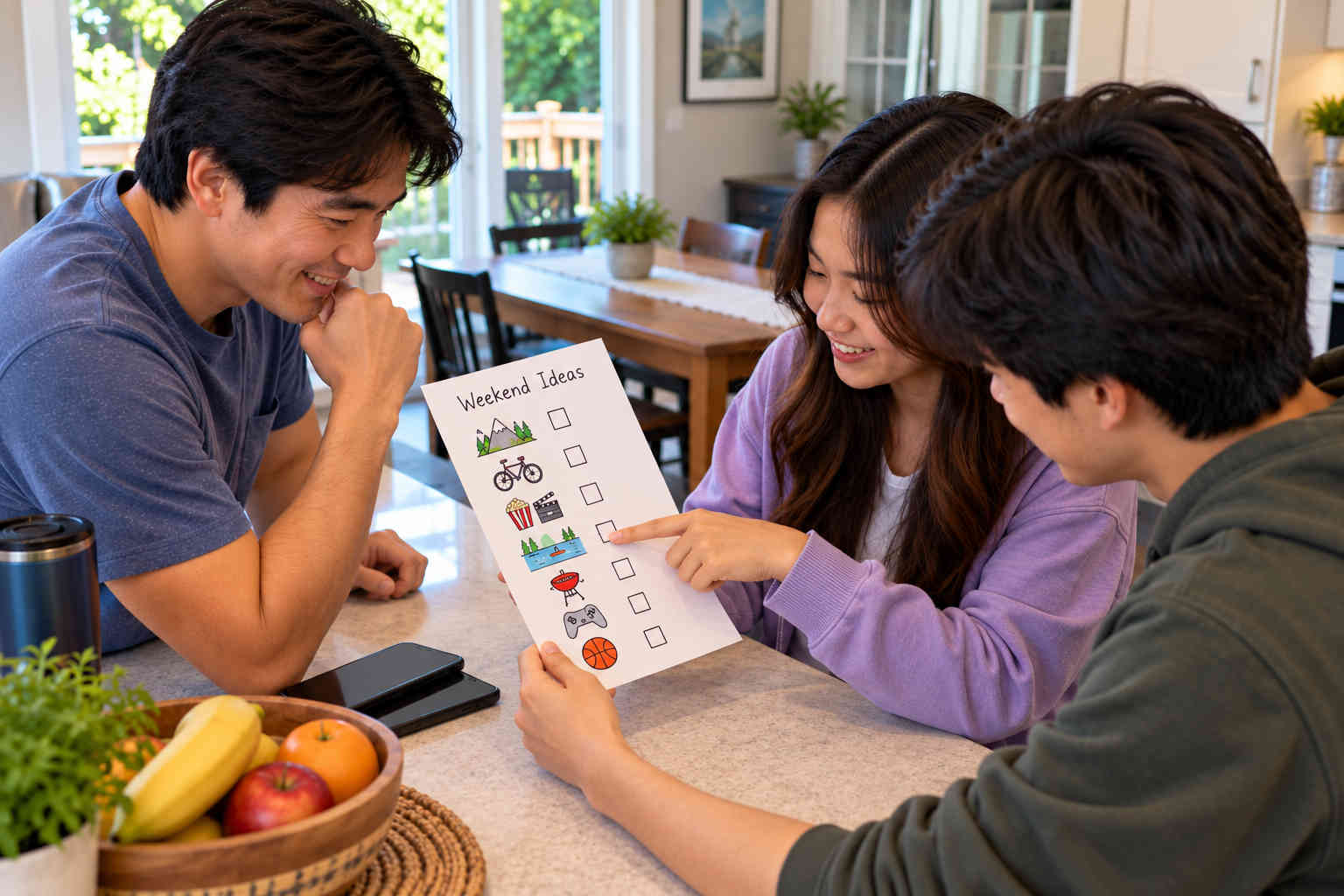
You can offer several choices or make a list together. The choices do not need to be expensive. A bike ride, movie, basketball game, favorite meal, arcade, hike, thrift-store challenge, dessert run, or home pizza night can be enough.
When children help choose the activity, they are more invested in it. You are also communicating something important: their preferences matter in your home.
Use Side-By-Side Time With Teenagers
Teenagers do not always want to sit across from a parent and discuss their feelings. They may talk much more while their hands are busy and their attention is partly focused on something else.
This is why side-by-side activities can be so useful. Driving, cooking, repairing something, walking, fishing, exercising, or working on a project removes the intensity of constant eye contact.
Do not fill every silence. Silence is not failure. Sometimes a teenager needs twenty quiet minutes before saying the one thing that actually matters.

Build Traditions That Compete With The Algorithm
Algorithms are powerful partly because they are predictable. Your child knows entertainment is waiting every time the phone opens. Family connection becomes stronger when it also has predictable moments.
Create small traditions your children can count on: Saturday pancakes, Friday pizza, a Sunday morning walk, a monthly movie night, a particular restaurant after practice, or a ridiculous family competition that nobody outside your house would understand.
Traditions do not have to be impressive. Their power comes from repetition. Over time, “what Dad and I do” becomes part of the relationship.

Respect The Social Life They Are Building
As children get older, friends become increasingly important. A divorced dad can accidentally compete with that social life because his parenting time feels scarce. You may think, “I only get this weekend. Why should she spend Saturday afternoon with friends?”
But maintaining a close relationship with your teenager does not require monopolizing every available hour.
Sometimes connection means driving your daughter to meet friends, knowing their names, welcoming them appropriately, and being the dependable father who makes her social life easier rather than treating it as a threat.

Protect The Ordinary Moments
Divorced fathers sometimes feel pressure to make parenting time memorable. That can lead to expensive outings and packed weekends. But children often bond through ordinary repetition more than spectacular events.
A breakfast conversation, a grocery-store trip, folding laundry while music plays, making dinner, or driving to practice may not feel important while it is happening. Those are exactly the moments in which children learn what it feels like to be around you.
If you are calm, interested, dependable, and emotionally available during ordinary life, you do not have to manufacture closeness every weekend.
Ask Better Questions
“How was school?” almost invites “Fine.” “What did you do today?” often produces “Nothing.” Try questions that are easier to answer and more specific.
Questions That Can Open A Conversation
What was the funniest thing that happened today?
Who is the easiest teacher to talk to?
What is everybody at school obsessed with right now?
What is something adults misunderstand about kids your age?
If you could change one rule at school, what would it be?
What are you looking forward to this month?
Then listen. Do not immediately turn every answer into advice, a warning, or a lesson. If children learn that sharing information always produces a lecture, they learn to share less information.
Make Connection More Important Than Control
You are still the parent. You can set limits, require responsibilities, and say no. But rules work better inside a relationship than in place of one.
If every interaction centers on grades, chores, bedtime, attitude, and screen time, your children may begin to experience you mainly as an authority system. They also need to know you enjoy them.
Laugh with them. Tell stories. Ask their opinion. Let them teach you something. Notice what they are good at. Tell them when you appreciate their effort, humor, judgment, kindness, or persistence.
Do Not Panic When They Pull Away
Adolescence naturally includes more independence. Your teenager may spend less time talking, want more privacy, and care more about friends than he did at ten. Divorce can make that normal separation feel much more threatening to a father.
Do not respond by chasing, guilt-tripping, or demanding emotional closeness. Stay available. Keep inviting. Keep the routines. Keep showing interest without forcing disclosure.
Your job is to leave the door open often enough that your child knows where to find you.

What Your Kids Will Remember
Your children probably will not remember exactly how many hours they spent on their phones during a particular weekend. They will remember the emotional pattern of being with you.
Did Dad seem irritated whenever I arrived? Did he spend the weekend trying to control me? Or did he know me? Did he listen? Did we laugh? Could I tell him things without immediately regretting it? Did he make room for my friends and interests? Was I expected to participate in the family without feeling trapped by it?
Those questions matter far more than winning one argument about a screen.
Quality Time Matters
Do Not Compete With The Phone. Build Something Better Around It.
Set reasonable boundaries, put your own phone down, create shared routines, respect your child's growing independence, and keep showing genuine interest. Connection after divorce is built through hundreds of ordinary moments in which your children learn that being with Dad feels safe, enjoyable, and worth looking up for.