Consistency Over Motivation
The Moment Motivation Leaves Is When The Habit Becomes Real
There is usually a strong beginning. You buy the shoes, clean out the refrigerator, open a new notebook, build a schedule, and tell yourself that this time will be different. For several days, maybe several weeks, the new routine feels energizing. Then the emotional weather changes.
You sleep badly. Work becomes demanding. A lonely weekend arrives. Your progress slows. The new habit stops feeling like a fresh start and begins feeling like another obligation. That is the moment many men assume something has gone wrong.
Nothing has gone wrong. You have simply reached the point where motivation can no longer carry the weight.
Learning how to stay consistent even when motivation disappears is not about becoming endlessly intense or turning yourself into a machine. It is about building a life in which useful actions do not depend on the mood you happen to wake up with.
For a man rebuilding his life after divorce, this matters even more. Emotional energy may rise and fall without warning. Some days feel hopeful. Others feel heavy, distracted, or strangely empty. If every good habit requires enthusiasm first, your health, finances, confidence, and future will be controlled by temporary feelings.
Consistency gives you another way to live. It allows a simple plan to carry you on the days when inspiration does not.

Stop Treating Motivation Like A Requirement
Motivation is useful, but it is unreliable. It arrives when a goal feels new, when progress is visible, or when life is relatively calm. It disappears when the work becomes repetitive, the results slow down, or another problem demands your attention.
The mistake is not losing motivation. The mistake is believing that motivation must return before you can act.
A more useful belief is this: action can happen before emotion changes. You can walk while feeling tired. You can prepare food while feeling uninspired. You can review your finances while feeling anxious. You can read one page while your mind tells you that a full chapter would be better.
This is the difference between motivation and consistency. Motivation asks, “Do I feel ready?” Consistency asks, “What is the next action I already decided to take?”
The second question is far more powerful because it reduces the amount of negotiation that happens inside your head.
Create A Minimum Version Of Every Important Habit
Most habits fail because they are designed only for ideal days. The workout assumes you have an hour. The meal plan assumes you have energy. The reading goal assumes you can concentrate. The financial review assumes nothing unexpected happened.
Real life does not offer ideal conditions every day. That is why every important habit needs two versions:
The Full Version
This is what you do when time, energy, and circumstances cooperate: a complete workout, a full meal-prep session, a focused hour of study, or a detailed weekly review.
The Minimum Version
This is the smallest action that still protects the habit: ten push-ups, one prepared meal, one page read, five minutes reviewing expenses, or a short walk around the block.
The minimum version is not a sign that you are lowering your standards. It is an emergency bridge that prevents one difficult day from becoming a broken routine.
A man who completes the minimum version is still casting a vote for the identity he is building. He is still proving, “I show up.” That proof matters more than one heroic performance followed by six days of avoidance.

Use The Never-Miss-Twice Rule
Perfect consistency is not the goal. Fast recovery is.
You will miss a workout. You will eat a meal you did not plan. You will skip your evening routine, overspend, stay up too late, or let a stressful week disrupt your schedule. One missed day is information. Two missed days can become a new direction.
The rule is simple: never miss twice when you have the ability to return.
If Tuesday falls apart, Wednesday becomes the recovery day. The recovery action does not need to be impressive. It only needs to interrupt the slide.
This rule prevents shame from turning a small mistake into a complete retreat. Instead of saying, “I already failed,” you say, “The next repetition matters more than the last one.”
That mindset is one of the strongest ways to stay consistent without motivation because it removes the expectation that you must feel confident before restarting.
Make The Good Choice Easier Before The Difficult Moment Arrives
Willpower is weakest when you are tired, distracted, emotional, or rushed. That is why the most important work often happens in advance.
You do not wait until 6:00 a.m. to decide where your running clothes are. You place them on the chair the night before. You do not wait until hunger is intense to decide what to eat. You prepare several simple meals on Sunday. You do not wait until your desk is covered with clutter to decide whether you can focus. You reset the workspace at the end of the day.

Environment design is not a trick. It is an admission that human behavior is heavily influenced by convenience.
- Keep workout clothes where you can see them.
- Put the book on the chair where you usually scroll.
- Move tempting food out of immediate reach.
- Automate savings and bill payments.
- Keep your notebook open to the next blank page.
- Charge your phone outside the bedroom.
The easier the useful action becomes, the less motivation it requires.

Decide When And Where The Habit Happens
Vague intentions create vague results. “I will exercise more” leaves too many unanswered questions. When? Where? For how long? What happens if the day becomes busy?
A useful habit has an appointment:
- After morning coffee, I will write my three priorities.
- At 6:15 p.m., I will walk for twenty minutes.
- After dinner, I will read five pages.
- On Sunday at 4:00 p.m., I will prepare meals for the first half of the week.
- Every payday, money will transfer automatically into savings.
This is how to build consistency without constantly “trying harder.” The routine carries part of the decision-making load.
Linking a new behavior to an existing routine is especially effective. The existing action becomes the reminder. After brushing your teeth, stretch. After lunch, take a short walk. After shutting down your laptop, prepare tomorrow's notebook.
Track Evidence, Not Emotion
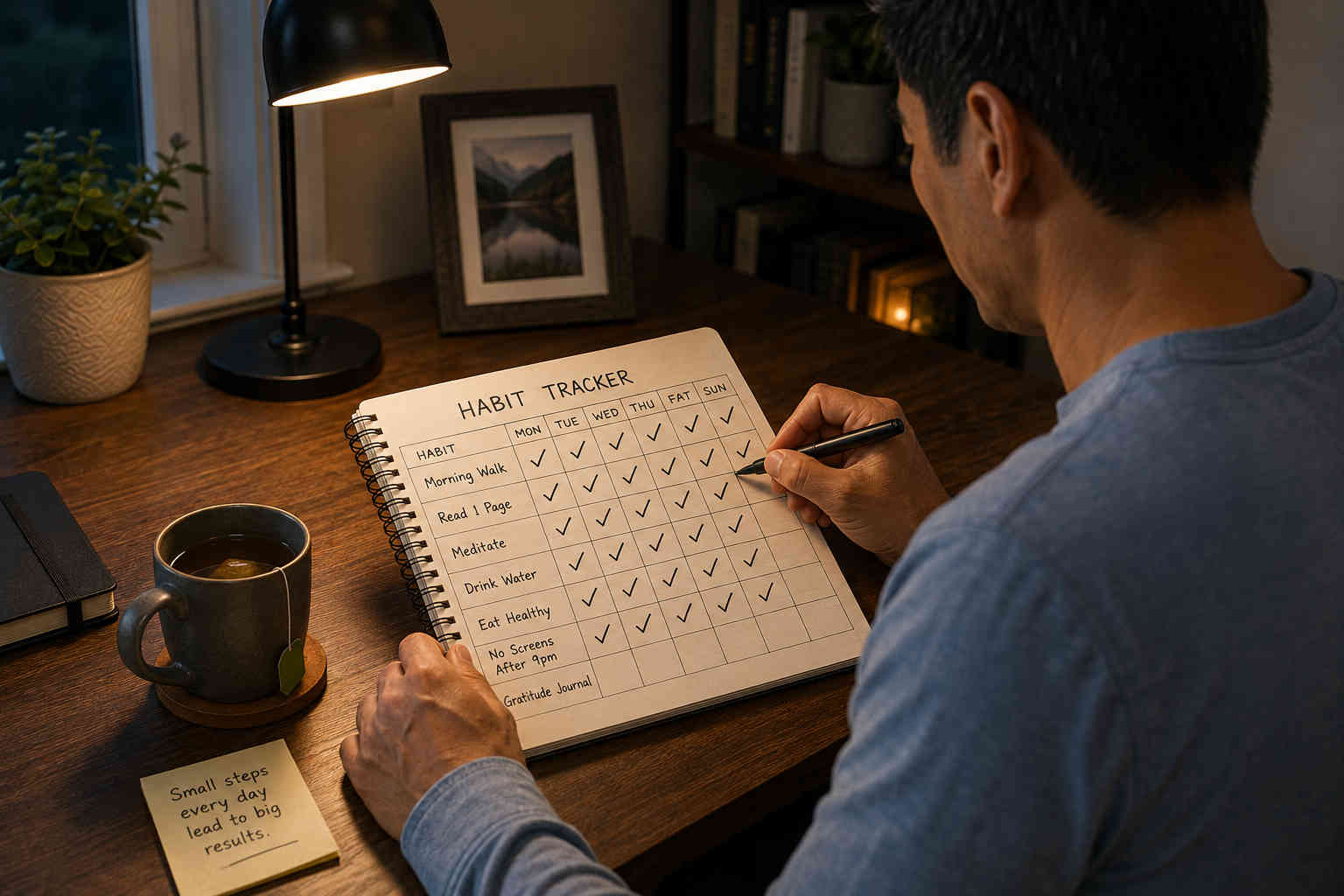
When progress feels slow, your mind can convince you that nothing is happening. A habit tracker provides evidence that your feelings may be wrong.
Marking a calendar is simple, but the meaning grows over time. One checkmark says you acted today. A month of checkmarks says you are becoming dependable.

Do not track too many habits at once. Choose the two or three behaviors that create the greatest improvement elsewhere. A morning walk may improve energy and sleep. Meal preparation may improve health and spending. A weekly review may improve work, finances, and emotional stability.
The tracker is not there to punish you. It is there to make the invisible visible.
Protect Momentum With A Reduced Pace
There will be seasons when the full routine is unrealistic. A demanding work project, family responsibility, illness, travel, or emotional setback may reduce what you can do.
The choice is not always “perform normally or quit.” Often the wiser choice is to reduce the pace while protecting the direction.
Walk instead of run. Prepare three meals instead of seven. Read for ten minutes instead of an hour. Save a smaller amount temporarily rather than stopping the transfer completely. Complete one important task instead of trying to rescue the entire day.
This approach preserves momentum without pretending your circumstances have not changed.

Expect Boredom Instead Of Mistaking It For Failure
New habits are exciting because they suggest a new identity. Repeated habits are less exciting because the novelty disappears. This is not a flaw in the process. It is the process.
Most meaningful results are produced during a long middle period when the action feels ordinary and the outcome remains incomplete. Savings grow slowly. Strength develops gradually. Confidence is rebuilt through many small promises kept. A better life is assembled from days that rarely feel historic while you are living them.
Boredom is often the price of mastery. The man who learns to continue after the routine stops entertaining him gains an enormous advantage over the man who constantly searches for a new beginning.
Build Identity Through Repetition
Goals tell you what you want. Identity tells you how you behave.
Instead of saying, “I want to work out,” say, “I am becoming a man who takes care of his body.” Instead of, “I want to stop overspending,” say, “I use money intentionally.” Instead of, “I want more confidence,” say, “I keep small promises to myself.”
Each completed habit becomes evidence for that identity. The evidence does not need to be dramatic. It only needs to be repeated.

Use A Weekly Reset Instead Of Waiting For A New Month
Many men wait for a symbolic restart: Monday, the first of the month, a birthday, or January. A weekly reset is more practical because it keeps the correction close to the mistake.
Once a week, ask:
- Which habits did I complete?
- Where did friction appear?
- Was the habit too large for my current schedule?
- What should I prepare in advance?
- What is the minimum version for next week?
- Which one habit would improve several areas of my life?
Do not use the review to criticize your character. Use it to improve the system. A missed habit may reveal that the time was unrealistic, the environment was working against you, or the goal was too ambitious.
Consistency improves when you become curious about failure instead of ashamed of it.
Remember What The Habit Is Really Building
The walk is not only about calories. It is about energy, health, and self-respect. The prepared meal is not only about nutrition. It is about reducing chaos. The financial review is not only about numbers. It is about creating peace. The book is not only about information. It is about becoming a man who continues to grow.
When motivation disappears, reconnect the action to the life it supports.
You are not trying to win a daily productivity contest. You are trying to create a life that feels more stable, capable, and intentional than the one you were living before.
Final Thoughts: Consistency Should Eventually Create Peace
The purpose of building better habits is not to spend every hour monitoring yourself. It is not to turn your home into a command center or your life into an endless checklist.
The purpose is freedom.
When useful actions become normal, they require less emotional effort. You stop arguing with yourself about every workout, every meal, every page, and every dollar. The routines begin carrying you.
Some days you will feel motivated. Enjoy those days. Use the extra energy. But do not build your future around the expectation that inspiration will always arrive on time.
Build minimum versions. Prepare the environment. Decide when the habit happens. Track evidence. Recover quickly. Reduce the pace when necessary without abandoning the direction.
Most importantly, keep proving to yourself that your actions are not controlled by every temporary feeling.
Your life will not change because you felt inspired for a week. It will change because ordinary days began containing better choices—and because you continued making those choices after the excitement disappeared.

Your Consistency Rule
Do The Smallest Useful Version And Protect Tomorrow
When motivation disappears, do not demand a heroic performance. Complete the minimum action, preserve the identity, and make the next repetition easier to begin.