Your Next Decade
Stop Asking What Will Happen And Decide What You Will Build
After divorce, it is easy to think in short blocks of time. You try to get through the next weekend alone, the next conversation with your ex-wife, the next bill, or the next holiday. That short-range thinking is useful during a crisis. It becomes dangerous when it turns into your permanent way of living.
A man can spend years reacting without realizing he has stopped directing his own life. He goes to work, handles responsibilities, watches television, scrolls through his phone, and waits for motivation to return. Nothing is dramatically wrong, but nothing meaningful is being constructed either.
Creating a vision for the next ten years of your life is not a motivational exercise. It is a decision to stop living by default. You are choosing the kind of man you want to become, the responsibilities you want to carry, and the evidence you want your life to contain ten years from now.
Your vision should not be a fantasy about becoming rich, admired, or permanently happy. It should be a working blueprint that helps you answer a more useful question every day: What would the man I am becoming do next?

Clear The Mental Drafting Table
Before you make a ten-year plan, identify the thinking that will sabotage it. Most men do not fail because they lack goals. They fail because they carry old mental rules into a new chapter.
You may still believe it is too late to start over, that you wasted your best years, or that one major mistake disqualifies you from building a meaningful future. You may believe confidence must return before you act. You may assume that because your marriage did not work, your judgment cannot be trusted.
Those beliefs feel like conclusions, but they are often emotional reactions repeated until they sound factual.
Write down the sentences that quietly limit you. Examples might include: “I am too old to change careers,” “I will never recover financially,” “I always quit,” or “Nobody wants to start over at my age.” Then challenge each one with a planning question.
- What skill could I develop over the next three years?
- What financial position could consistent saving create over ten years?
- What evidence would prove I am becoming more disciplined?
- What would happen if I treated this as training instead of a final verdict?
You do not need to feel optimistic before planning. You need to stop treating your current mood as an accurate forecast of the next decade.
Design The Whole Life, Not One Impressive Goal
A weak vision is usually built around one outcome: make more money, lose weight, find another relationship, retire, or move somewhere new. Those goals may matter, but one achievement cannot carry an entire life.
A better ten-year life vision considers the major areas that determine whether your future feels strong or hollow: health, career, relationships, finances, adventure, learning, faith or guiding values, and legacy.
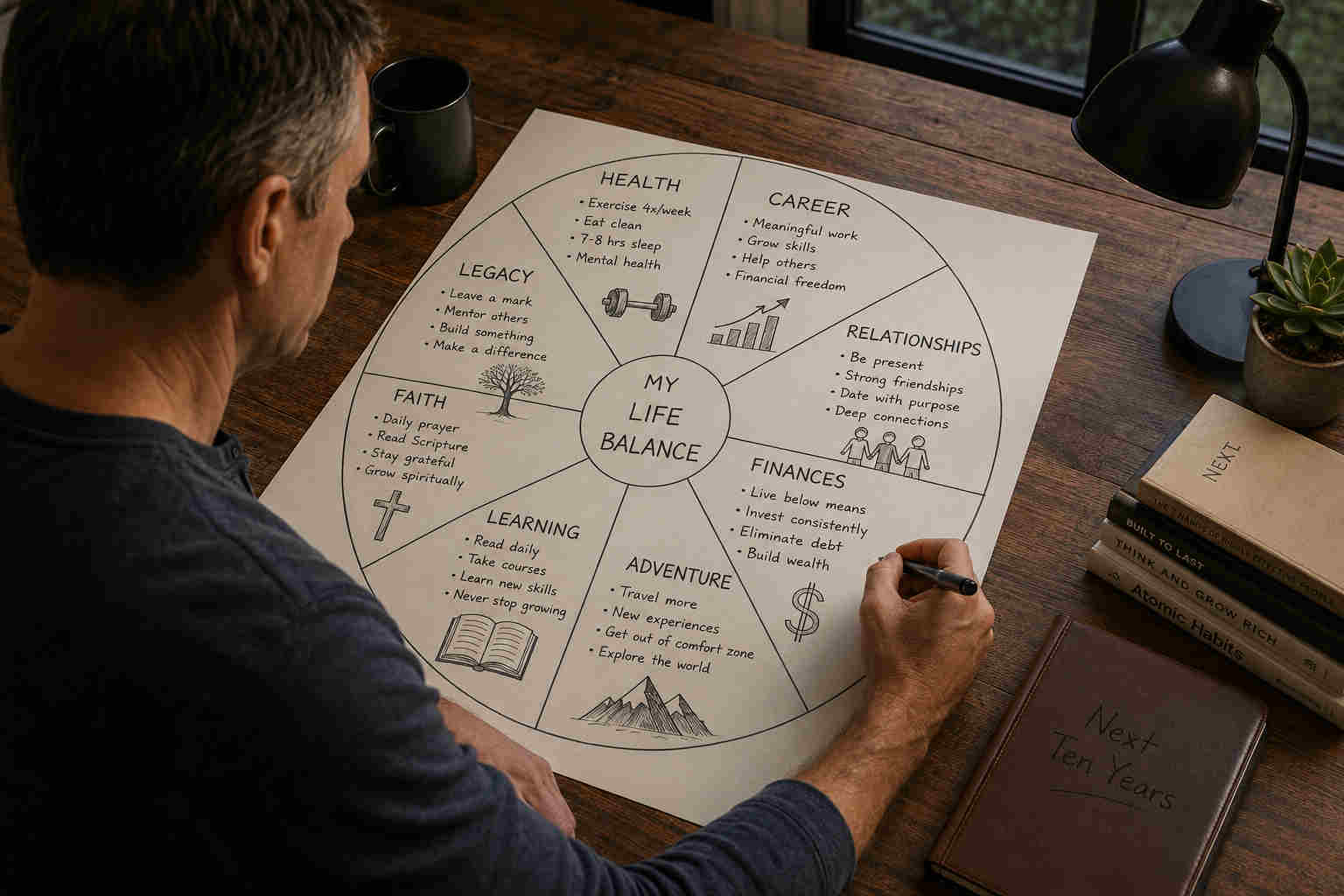
Give each area a one-sentence ten-year outcome. Make it observable.
- Health: I am physically capable, maintain a healthy weight, and can travel or hike without being limited by poor conditioning.
- Career: I do work that uses my strongest abilities and gives me more control over my time.
- Relationships: I have dependable friendships, a close relationship with my children, and healthy standards for future dating.
- Finances: I have eliminated consumer debt, built retirement security, and created enough margin to handle emergencies.
- Adventure: I regularly experience places, activities, and challenges that keep life from becoming small.
- Learning: I continue developing skills instead of allowing age to become an excuse for stagnation.
- Faith or values: My decisions reflect principles I have chosen rather than moods I happen to feel.
- Legacy: Someone is stronger, wiser, or better prepared because I showed up consistently.
This is not about achieving perfect balance every week. It is about preventing one urgent area from consuming the entire decade.
Build The Identity Before You Chase The Outcome
Most goals are written as possessions or achievements: a better body, a certain income, a new business, a strong relationship, or a paid-off house. Those are results. Results are important, but they arrive late.
Identity comes first.
Instead of saying, “I want to get in shape,” decide, “I am becoming a man who trains even when he does not feel motivated.” Instead of “I want financial freedom,” use, “I am a man who invests before spending.” Instead of “I want confidence,” choose, “I do one uncomfortable but useful thing every week.”

Identity-based goals change the daily decision. You are no longer asking whether you feel like exercising, saving, reading, apologizing, or doing difficult work. You are asking whether the action matches the man you have decided to become.
Write five identity statements for your next decade. Keep them practical. “I am dependable.” “I finish what I schedule.” “I tell the truth early.” “I take care of my body.” “I use money intentionally.” These become personal operating rules.
Reverse Engineer The Mountain
Ten years feels distant enough to inspire imagination but too distant to guide Monday morning. That is why your vision must be broken into levels.
Start at the summit. Describe what you want to be true ten years from now. Then work backward.
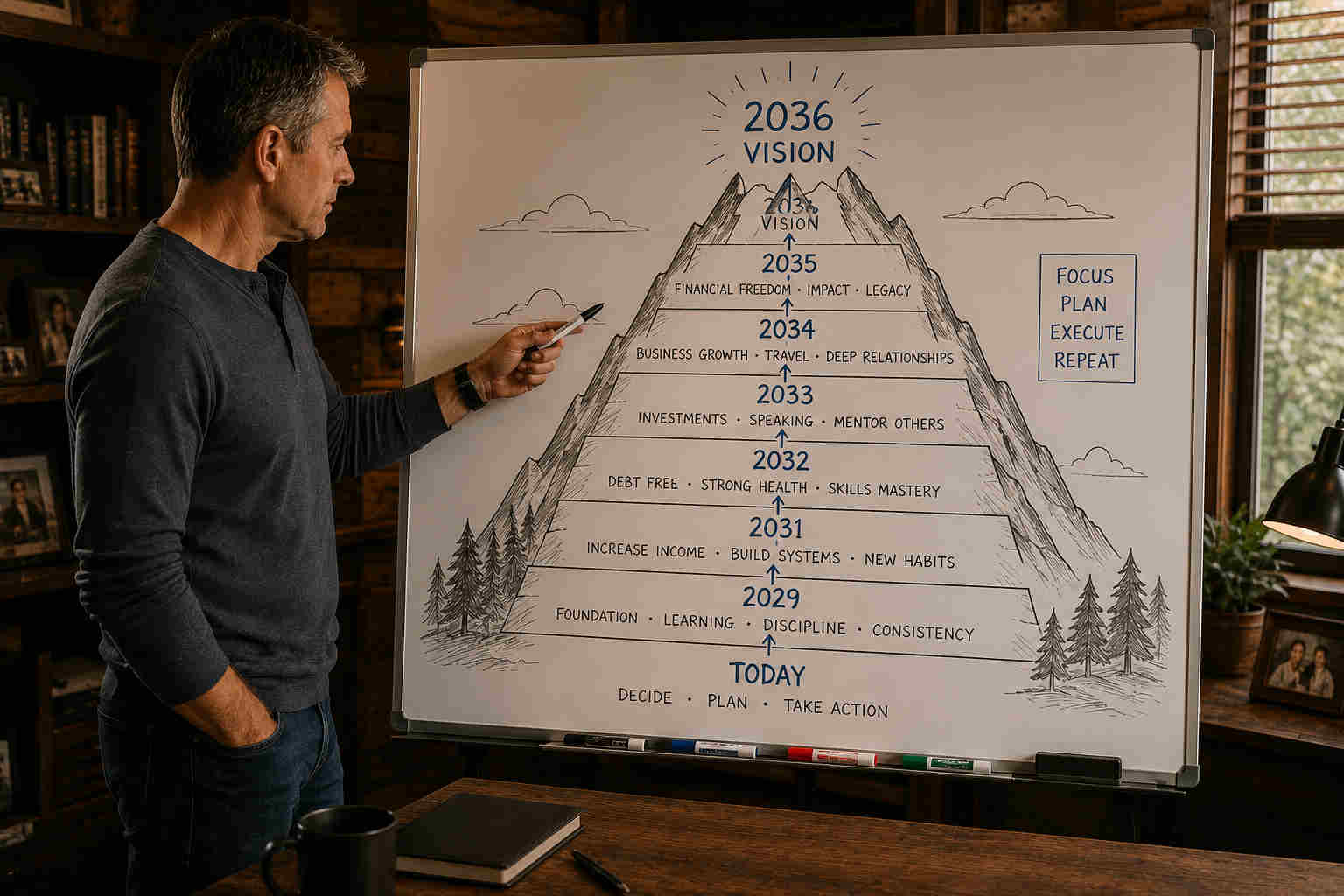
Ten Years
Describe the life you want to be living, the man you want to be, and the responsibilities you want to handle well.
Five Years
Identify the position that would make the ten-year outcome realistic. This may include career experience, savings, health improvements, certifications, relationships, or a completed project.
Three Years
Choose the major foundation. What must be established before larger opportunities become possible?
One Year
Select three to five measurable results that would make this year a genuine step forward.
Next 90 Days
Choose one project in each of your two most important areas. Give each project a deadline and visible finish line.
This Week
Schedule the actual actions. A goal without a place on the calendar is only a preference.
Do not try to map every year with false precision. Your plan will change. The purpose of reverse engineering is not to predict every event. It is to make sure your current behavior has a logical connection to the future you say you want.
Measure Repetitions, Not Just Time
People often say they have been trying to change for years. Time alone does not create progress. Repetitions do.
A man may say he has been learning guitar for two years, but the meaningful number is how many times he practiced. He may say he has been trying to get healthy since January, but the useful numbers are workouts completed, meals prepared, hours slept, and medical appointments kept.
Turn your ten-year vision into repetition math.
- Three workouts a week becomes more than 1,500 training sessions in ten years.
- Investing every payday creates roughly 260 intentional contributions over a decade.
- Reading twenty pages a day can produce hundreds of completed books.
- One meaningful conversation with your child each week becomes more than 500 moments of deliberate connection.
- One uncomfortable growth action every week becomes a decade of courage practice.
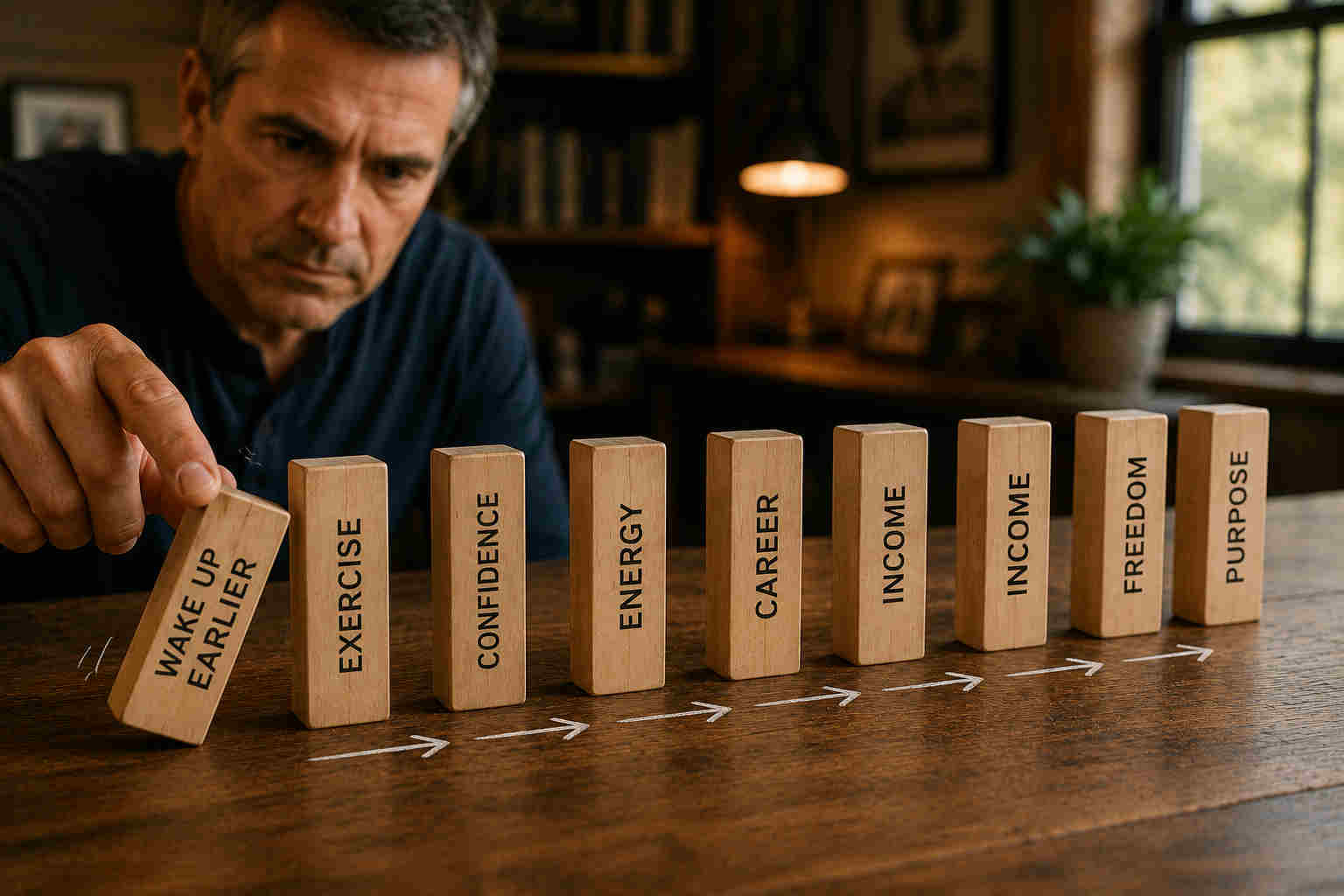
Repetitions remove drama. You do not have to transform your life this month. You have to complete the next repetition often enough for a new life to become mathematically likely.
Build Systems That Work When Motivation Does Not
Motivation is an unreliable employee. It appears when the goal is new, disappears when life becomes difficult, and returns after the work has already been done.
A system is stronger because it decides in advance.
- Exercise happens Monday, Wednesday, and Friday at a fixed time.
- Saving happens automatically on payday.
- Family calls are scheduled instead of left to good intentions.
- Skill development has a recurring block on the calendar.
- The phone stays outside the bedroom so sleep does not depend on willpower.
The best system makes the useful action easier and the destructive action more inconvenient.

Put running shoes beside the door. Remove food that repeatedly defeats you. Place the book you intend to read on the chair where you usually scroll. Automate bills and investments. Keep your written goals visible. Design the room so the right action is obvious.
Hold A Weekly Meeting With Your Life
Businesses review performance because unmanaged activity becomes expensive. Your life deserves the same attention.
Set aside thirty to forty-five minutes every Sunday for a personal weekly review. Treat it like a meeting that cannot be casually canceled.
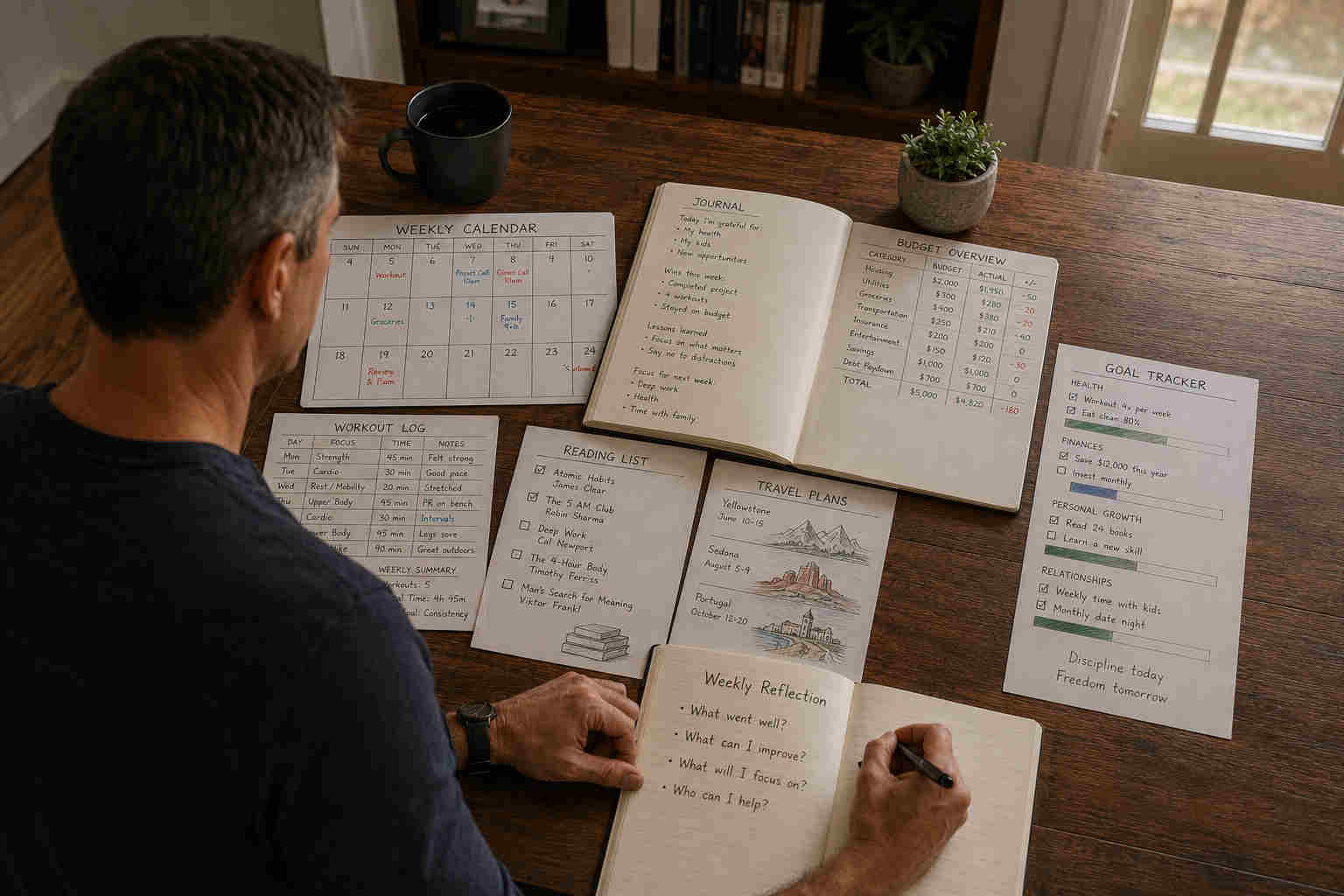
Review seven items:
- Calendar: What did I actually spend time on?
- Health: Did I train, sleep, and eat according to my standards?
- Money: Did spending support or weaken the plan?
- Relationships: Who received my attention, and who did I neglect?
- Work: What meaningful result did I complete?
- Learning: What did I practice, study, or improve?
- Next week: What are the three actions that matter most?
The goal is not to criticize yourself. The goal is to notice drift while the correction is still small.
Use Annual Themes Instead Of Trying To Fix Everything At Once
A ten-year plan becomes exhausting when every area feels urgent. One practical solution is to give each year a central theme.
Your first year might be Foundation: stabilizing finances, sleep, health, and routine. The second might be Strength: building physical capacity and emotional discipline. Another year could focus on Expansion: travel, education, or a career move. Later themes might include Connection, Mastery, Contribution, or Legacy.
You still maintain the other areas, but one theme receives extra attention. This prevents scattered effort and allows each year to produce a recognizable chapter.
Create A Future Resume
Write a resume dated ten years from today. Do not list job duties. List evidence of the life you built.
It might say:
- Maintained a strong relationship with my children through weekly contact and dependable presence.
- Eliminated high-interest debt and built a retirement portfolio.
- Completed 1,200 workouts and became physically capable again.
- Learned conversational Spanish and traveled through three countries where I used it.
- Mentored younger men entering my profession.
- Built a side business that created meaningful income.
- Developed friendships that were based on shared values rather than convenience.
- Handled future relationships with stronger boundaries and better judgment.
Then circle the items that require action this year. A future resume turns vague hope into evidence you can begin collecting now.

Expect Detours Without Abandoning The Direction
Your ten-year life plan will not unfold exactly as written. Jobs change. Parents age. Children need different things. Health issues appear. Relationships begin or end. Opportunities arrive that you could not have predicted.
Flexibility does not mean the vision failed. It means the route changed.
Keep the deeper direction even when a specific goal becomes outdated. You may change careers but keep the goal of meaningful work. You may choose a different financial target while continuing to build security. You may abandon one travel plan while preserving adventure and learning.
Review your ten-year vision once a year. Remove goals that were based on ego, comparison, or an outdated version of yourself. Strengthen the goals that still create energy and responsibility.
Final Thoughts: Planning Must Eventually Become Living
A blueprint matters only because someone eventually begins construction.
You can spend months choosing goals, building spreadsheets, watching productivity videos, and rewriting your vision statement. Planning can become a sophisticated form of avoidance. At some point, the next decade requires a phone call, an automatic transfer, a workout, a difficult conversation, a completed application, or a first day as a beginner.
The purpose of a ten-year vision is not to control the future. It is to make your present decisions more intentional.
Ten years from now, you will not remember every motivational thought you had today. You will live inside the accumulated results of what you repeatedly did.
Choose the man you want to become. Define the life areas that matter. Work backward from the long horizon. Build systems. Count repetitions. Review your direction every week. Adjust without drifting.
Your next decade does not need a dramatic beginning.
It needs an honest blueprint—and one action completed today.

Your Ten-Year Rule
Do Not Wait To Feel Like Your Future Self
Choose one action that matches the man you intend to become, put it on this week's calendar, and complete the repetition. Identity follows evidence.