
Dating Readiness for Men
What You Cannot See Can Still Shape Your Relationships
You can leave a marriage, change your address, change your routine, and meet someone entirely different—and still bring the same invisible habits into the next relationship.
Consider a man who describes himself as dependable. During his marriage, he fixed the broken appliances, handled emergencies, and rarely missed a responsibility. Yet his wife often said she felt alone. He heard that as an unfair dismissal of everything he did. Years later, while dating someone new, he offers to repair her kitchen cabinets when she really wants him to sit down and ask about her day.
His problem is not that dependability is bad. It is that he cannot see when his preferred way of loving someone prevents him from noticing how that person actually experiences him. That is a relationship blind spot : a recurring behavior, assumption, or emotional reflex that affects your relationships more than you realize.
After divorce, spotting these patterns matters more than assembling a list of what your ex-wife did wrong. You do not have to accept all the blame for a marriage ending. You do have to become curious about the part of the story you could not see from inside it.
Your Greatest Strength May Also Be Your Greatest Blind Spot
Many blind spots begin as admirable qualities. A decisive man becomes controlling when he makes every choice. A generous man becomes resentful when he never says no. A calm man becomes unreachable when he uses composure to avoid difficult conversations.
Imagine spending Saturday assembling an elaborate bookcase while your partner waits at the dining table. You are thinking, “I am making our home better.” She is thinking, “He would rather work on furniture than spend an hour with me.” Neither interpretation tells the whole story.
Ask yourself: When does my best quality become too much of a good thing? Then ask the more uncomfortable question: What might it cost someone to be on the receiving end of that quality? Strength becomes maturity when you can adjust it to the situation rather than use it automatically.

The Story You Tell About Your Divorce May Have Missing Pieces
Most people build a coherent story about why their marriage ended. Perhaps yours is that your ex-wife was impossible to please, emotionally distant, or uninterested in working things out. Parts of that account may be entirely accurate. But a story can be true in what it includes and incomplete in what it leaves out.
Picture your marriage as a table covered with photographs: the wedding, a vacation, a holiday dinner, and an ordinary evening when both of you sat together but felt miles apart. If you select only the happiest pictures, you miss the disconnection. If you select only the worst ones, you miss why you stayed.
Instead of asking who was the villain, ask what each of you repeatedly tried to communicate, what changed over time, and what you dismissed because it did not fit your understanding. The goal is not to rewrite history to make yourself guilty. It is to stop using a simplified history as a map for your future.

Notice What You Consistently Misinterpret
A woman you have been seeing does not answer a text for several hours. Your first thought is that she is losing interest. You reread your last message, become irritated, and consider sending something sarcastic. Meanwhile, she is in a meeting with her phone silenced.
The blind spot is not the delayed reply. It is the meaning you assign to it before gathering information. Some men interpret independence as rejection, a request for space as punishment, or a direct question as criticism. Their reactions then create the very tension they feared.
Try separating three things on paper: what happened , what I assumed , and what else might explain it . “She has not replied since lunch” is an observation. “She is deliberately ignoring me” is an interpretation. You can acknowledge uncertainty without pretending that your feelings are imaginary.

Conduct a Relationship Autopsy Without Putting Yourself on Trial
A useful relationship autopsy examines patterns rather than prosecuting either person. Choose three recurring arguments from your marriage. For each, write down what started it, how you responded, what your spouse said she needed, and how the argument usually ended.
Look for the moment you stopped listening. Did you move immediately into problem-solving? Did you demand evidence for her feelings? Did you withdraw until she apologized? Did you become agreeable in the moment and then quietly do nothing differently?
Be equally clear about harmful behavior you experienced. Self-awareness does not require excusing manipulation, intimidation, betrayal, or abuse. Where the relationship was unsafe, a counselor or other qualified professional may help you sort responsibility from self-blame.
One honest observation is worth more than twenty vague promises to “communicate better.”
Are You Confusing Being Needed With Being Loved?
Some men feel most secure when they are indispensable. They volunteer to move furniture, repair cars, pay bills, solve problems, and absorb inconveniences. The effort may be generous, but it can also become a quiet bargain: If I am useful enough, she will not leave.
That bargain makes boundaries difficult. You agree to carry more boxes than you can manage, then feel unappreciated when your sacrifice goes unnoticed. The other person may not even realize you wanted recognition because you never expressed a limit.
Before offering help, ask whether you genuinely want to give it and whether you could tolerate hearing “no, thanks.” Love should include care, but it should not depend on making yourself permanently necessary. A partner can appreciate you even when you are not rescuing her from anything.

Your Conflict Style May Be Creating the Distance You Fear
Some couples have explosive arguments. Others have arguments that never quite happen. You stand at the sink washing the same glass while your partner waits for you to respond. You believe silence is keeping the peace. She experiences it as abandonment.
Conflict avoidance can look respectable from the inside: you are not yelling, insulting, or escalating. But if you consistently refuse to discuss uncomfortable subjects, unresolved problems accumulate. On the other hand, pushing for an immediate answer when someone needs time can also become a blind spot.
Practice naming the process rather than disappearing into it: “I want to talk about this, but I am getting defensive. Can we take twenty minutes and come back?” The crucial part is returning when you said you would. A pause becomes healthy when it supports a conversation, not when it replaces one.

Pay Attention to Complaints You Have Heard More Than Once
One person's criticism may be mistaken. The same observation from several unrelated people deserves attention. Perhaps your ex-wife said you never asked follow-up questions. Years earlier, a friend called you a good storyteller but a poor listener. Now someone you are dating says she cannot get a word in.
You do not have to accept every accusation as fact. Instead, search for a repeatable behavior beneath the emotional wording. “You make everything about you” may point to interrupting, giving unsolicited advice, or turning someone else's story into an example from your own life.
Ask one trusted friend a specific question: “When I am stressed or trying to help, what do I do that makes conversations harder?” Listen without explaining your intentions. Thank them. Then watch for the behavior in real time. Feedback becomes useful only when you can observe it for yourself.

Identify the Invisible Relationship Rules You Inherited
Every family teaches relationship rules, often without saying them aloud. Perhaps your father worked long hours and showed love by providing. Perhaps your mother handled every emotional conversation. Maybe affection was rare, disagreements were hidden, or apologies were considered weakness.
These examples can become internal commandments: “A man must always have the answer.” “Talking about feelings makes things worse.” “If I provide enough, my partner should know I care.” Such rules may have helped you survive or succeed in one environment while limiting intimacy in another.
Write down five beliefs that begin with “A good husband should…” or “Women always…” Ask where each came from and whether it is still useful. You are allowed to respect your parents without reproducing every aspect of their marriage. An inherited rule is a starting point, not a lifelong obligation.

Watch What Rejection Brings Out in You
A disappointing date can reveal a blind spot faster than a successful one. Do you become sarcastic? Send repeated messages? Pretend you were never interested? Immediately search for someone new so you do not have to sit with disappointment?
Imagine sitting in your parked car after a date that felt promising but ended awkwardly. Your phone is on the passenger seat. Nothing requires you to make a decision tonight. Yet the urge to restore your pride can feel urgent.
Give yourself a short waiting period before responding to rejection. Ask, “What am I trying to make this person feel?” and “Would I send this message if I felt secure?” Rejection hurts, but it does not have to turn you into someone who pressures, punishes, or pursues another person for reassurance.

Stop Dating to Correct the Past
After divorce, a new relationship can quietly become an attempt to rewrite the old one. You may seek a woman who is the opposite of your ex-wife in every visible way. Or you may chase someone emotionally unavailable because winning her affection would feel like proof that you are finally enough.
Neither strategy asks the central question: Are we actually compatible? When dating becomes a courtroom appeal against your marriage, you stop seeing the person in front of you clearly.
Notice whether your attraction is based on who she is or on what her interest would prove about you. A new partner cannot deliver a verdict that permanently settles the pain of your divorce. She deserves to be known as an individual, not recruited to repair your past.
The Five-Question Relationship Blind Spot Audit
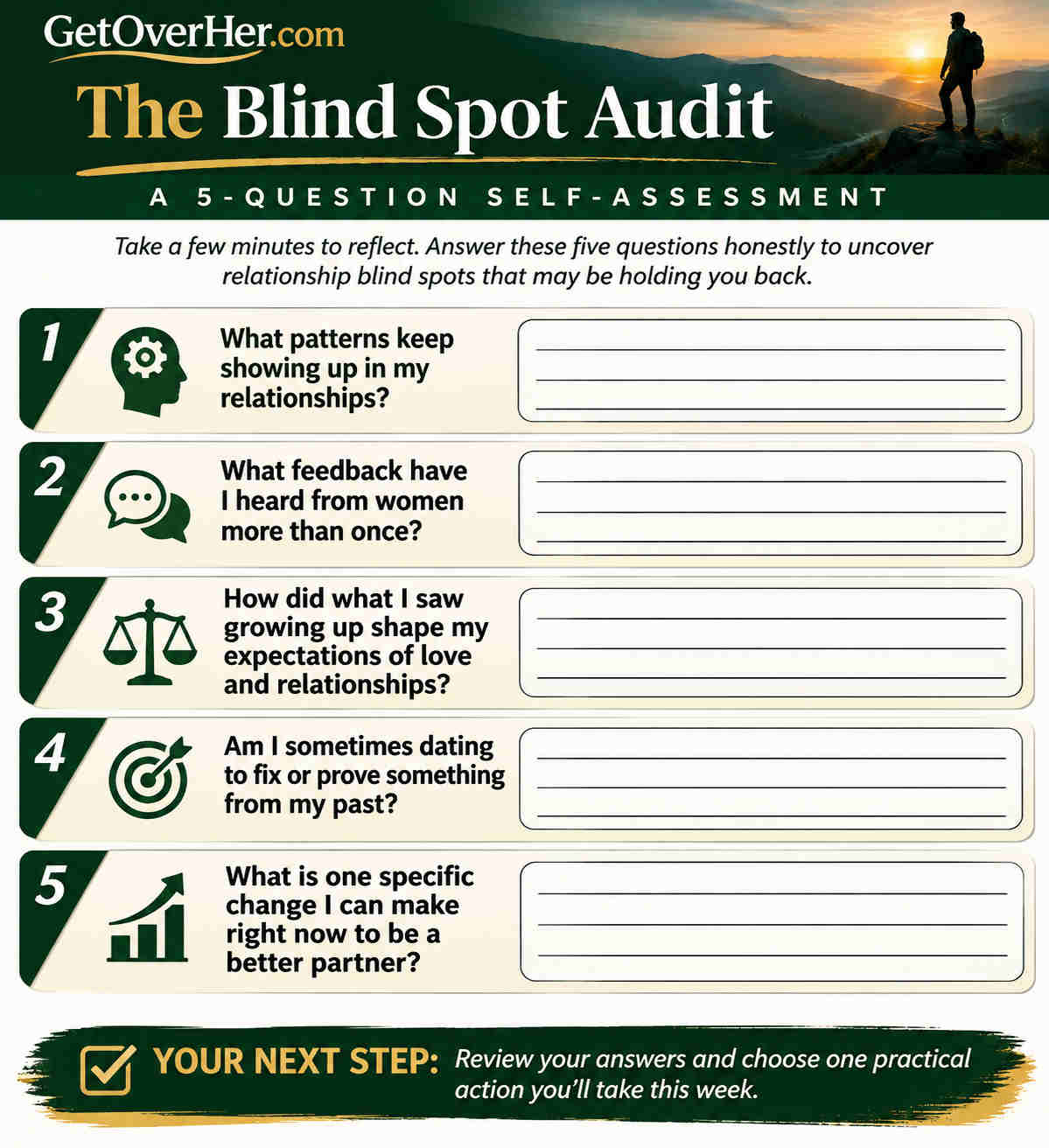
You do not need a complicated personality test to begin. Set aside twenty quiet minutes and answer these five questions using actual examples, not the person you hope to become:
- What patterns keep showing up in my relationships?
- What feedback have I heard from women more than once?
- How did what I saw growing up shape my expectations of love and relationships?
- Am I sometimes dating to fix or prove something from my past?
- What is one specific change I can make right now to be a better partner?
Write a behavior for the last answer, not a personality label. “I will ask a follow-up question before offering advice” is more actionable than “I will be emotionally intelligent.” Save or print the audit and revisit it after several weeks.
Ask for Evidence, Not Reassurance
Self-reflection has a limit: you can explain almost anything to yourself. That is why useful change involves testing your conclusions against reality. If you suspect you interrupt people, track how often you speak before they finish. If you think you withdraw during conflict, notice the exact moment you stop responding.
Choose one behavior and ask a trusted person to tell you when they observe it. You are not asking them to declare you a good man. You are asking for information that helps you become a more attentive one.
Expect some awkwardness. Seeing a blind spot can sting because it interrupts your preferred self-image. The discomfort is not proof you are failing; it may be the first sign that you are noticing something new.
Change One Pattern Before Trying to Change Everything
Men sometimes leave an article like this determined to transform their entire emotional lives in a weekend. By Tuesday, the plan has collapsed. A better approach is a small experiment that you can repeat.
For two weeks, choose one behavior. If you jump into fixing mode, ask, “Do you want advice or do you want me to listen?” If you assume silence means rejection, wait for more evidence before reacting. If you say yes when you mean no, practice one respectful boundary.
At the end of each day, note one occasion when the old impulse appeared and what you did instead. You are building the ability to recognize a fork in the road while you are still standing at it—not only after the damage is done.
Date With Curiosity Instead of a Script
Dating after divorce becomes less exhausting when you stop trying to prove you have mastered relationships. You can be interested without being intrusive, honest without oversharing, and attentive without turning every conversation into a performance.
When a woman describes a difficult workday, resist assuming she wants a solution. When she expresses a preference unlike yours, resist treating it as a compatibility crisis. Ask a question that reveals how she sees the world. Let the answer change your understanding.
The point is not to become perfectly agreeable. It is to become flexible enough to notice another person's experience while still expressing your own. That is the opposite of living on autopilot.
See the Pattern Before It Repeats
Imagine walking beside someone new along a waterfront late in the afternoon. She is telling you a story, and for once you are not rehearsing advice, searching for a hidden criticism, or wondering what her reaction says about your worth. You are simply listening.
You will still misread situations. You may still retreat when you are hurt or become too eager to solve a problem. The difference is that you can catch yourself earlier, acknowledge it without a lengthy defense, and choose another response.
That is what self-awareness in relationships looks like in practice. Not flawless behavior. Not a dramatic personality makeover. Just the growing ability to see what you are doing while there is still time to do something different.

The Takeaway
You Cannot Change What You Refuse to Notice
Your blind spots are not your entire identity. They are habits and assumptions that become visible when you get curious about their effects. You can acknowledge your part in past relationship problems without carrying all the blame. And you can approach a new relationship without asking it to repair the old one.
Start with one pattern, one honest observation, and one different response. The next chapter of your dating life does not have to repeat the last.