
Why Your Brain Keeps Replaying The Past
Your mind is not returning to the divorce because it enjoys hurting you. It is trying to solve a threat. A marriage ending can disrupt your home, finances, parenting rhythm, identity, friendships, routines, and expectations about the future. Your brain treats that level of loss as unfinished business.
It reopens old conversations because it assumes there must be a missing answer. It searches text messages, facial expressions, financial decisions, and ordinary moments for a clue that explains everything. The process creates the sensation of control: if you can identify exactly where the marriage went wrong, perhaps you can prevent the pain from ever happening again.
The problem is that divorce rarely has one clean cause. A relationship is a living system. Timing, personality, stress, communication, health, money, family history, attraction, resentment, expectations, and thousands of small choices can interact over years. Your brain wants a simple answer because a simple answer feels manageable. Real life is usually less tidy.

Reflection And Rumination Are Not The Same Thing
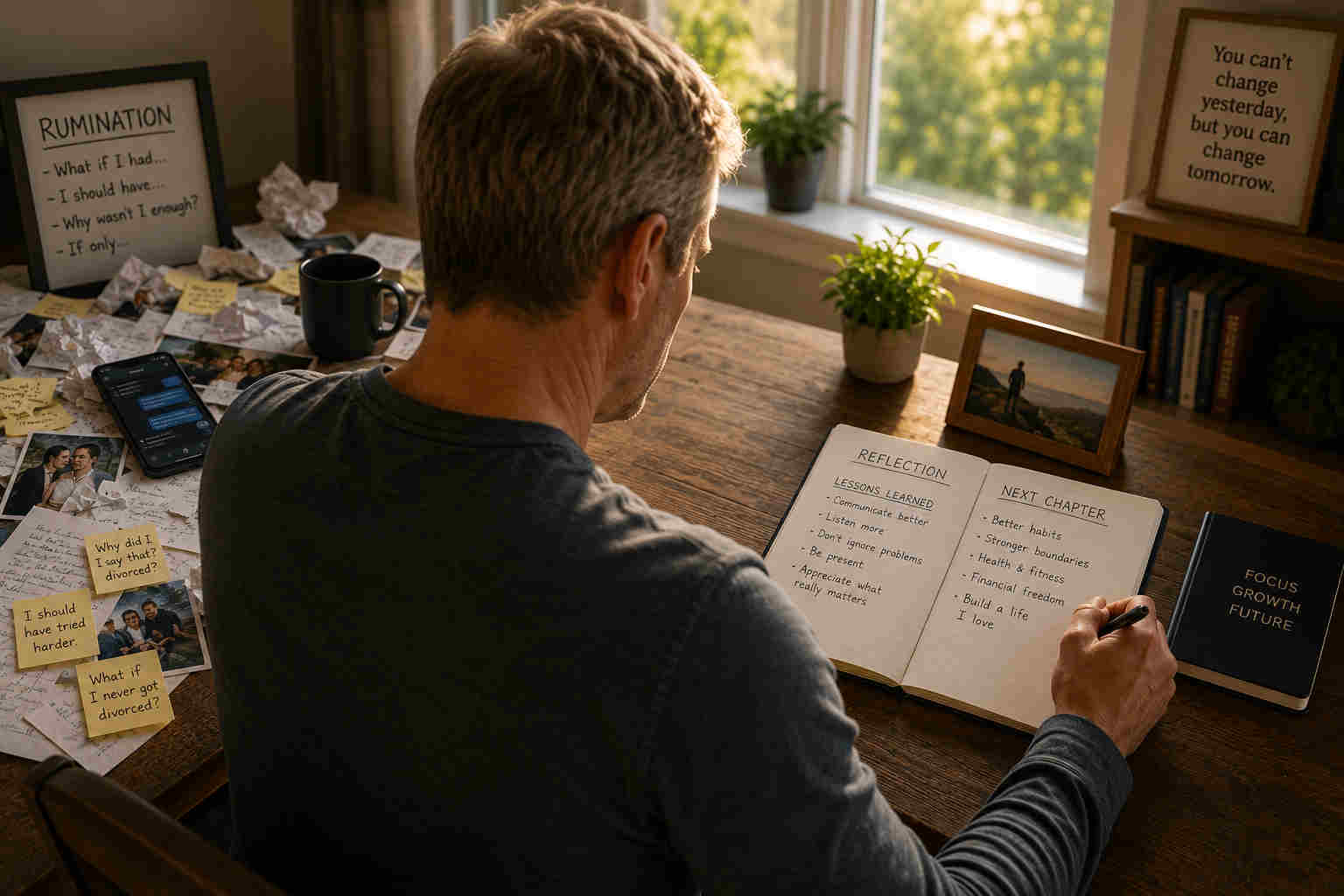
Thinking about your marriage is not automatically unhealthy. Honest reflection is part of emotional healing after divorce. It helps you identify patterns, take responsibility, and make better choices in future relationships.
Reflection has a destination. It leads to a lesson, decision, boundary, apology, or change in behavior. Rumination has no destination. It circles the same emotional territory and leaves you more depleted than when you began.
Reflection sounds like this:
- I avoided difficult conversations, so I need to practice speaking earlier and more directly.
- I ignored warning signs because I feared being alone.
- I allowed resentment to replace communication.
- I need healthier boundaries with work, money, family, or conflict.
Rumination sounds like this:
- How could I have been so stupid?
- Why was I not enough?
- What if that one argument ruined everything?
- What if I never find anyone again?
A useful test is simple: after thinking about the marriage, do you know what you will do differently? If the answer is yes, you may be reflecting. If you only feel ashamed, agitated, or desperate to rerun the memory again, you are probably ruminating.
The Fantasy Of The Perfect Alternate Timeline
One of the most persuasive forms of regret is the alternate timeline: the imaginary life in which you made one better decision and everything worked out.
In that version, you took the vacation, accepted the job, rejected the job, noticed her unhappiness, controlled your anger, became more affectionate, spent less money, defended her more, gave her more space, or insisted on counseling before the relationship became critical.
Notice what the fantasy usually excludes. It does not include new conflicts, your spouse's choices, unresolved incompatibilities, outside pressures, or the possibility that the marriage still ended. Your mind changes one variable while holding every other condition perfectly still. Real relationships do not work that way.
You are comparing an actual marriage—with all its ambiguity and pain—to a fictional marriage designed by hindsight. Reality cannot win that comparison.

Stop Looking For The One Moment That Changed Everything
Many divorced men search for a single turning point. They identify the affair, the move, the promotion, the missed anniversary, the explosive argument, or the night one person slept in another room. That moment becomes the explanation for the entire marriage.
Sometimes a major event truly changes a relationship. More often, however, the visible event is the point at which a longer process became impossible to ignore. Distance may have accumulated through years of small disappointments, unspoken expectations, repeated defenses, and ordinary neglect.
Obsessing over one moment creates the illusion that everything before it was secure and everything after it was inevitable. That story may be emotionally convenient, but it is rarely complete.
You are allowed to say, “This mattered,” without forcing yourself to say, “This explains everything.”

Judge Your Past Self By What He Knew Then
Hindsight makes your earlier choices look obvious. Today, you can recognize patterns you missed, words you should not have used, and actions you should have taken. But today's knowledge was purchased by the experience itself.
You may now understand attachment, conflict, boundaries, emotional availability, or communication in ways you did not understand during the marriage. That does not erase responsibility. It does make it unfair to pretend your past self had access to everything you know now.
Ask a more honest question: given the maturity, information, stress, habits, and emotional skills I had at the time, why did that choice make sense to me then?
The answer may be uncomfortable. Perhaps you were afraid, proud, exhausted, insecure, avoidant, angry, or convinced the problem would resolve itself. Understanding the reason is not the same as approving the behavior. It gives you something specific to change.
Guilt Can Teach You; Shame Only Defines You
Guilt says, “I did something that hurt the marriage.” Shame says, “I am the kind of man who ruins everything.”
Guilt can be useful when it leads to accountability. You can apologize where appropriate, repair relationships with your children, change financial habits, learn to communicate, or seek professional help. Shame does not ask you to improve. It asks you to accept a permanent identity as a failure.
That identity can quietly damage your future. A man who believes he ruins relationships may tolerate poor treatment, avoid intimacy, overcompensate in dating, or sabotage healthy connections before they become serious.
Your mistakes deserve examination. They do not deserve ownership of your name.
Stop Rewriting Conversations That Cannot Change
One of the most exhausting habits after divorce is mentally editing old conversations. You invent the perfect response, the calmer tone, the stronger boundary, or the sentence that would have finally made your former spouse understand.
The revised conversation may feel satisfying for a few seconds, but it trains your brain to return to the scene. Each replay strengthens the pathway. Soon the memory appears automatically while driving, showering, working, or trying to sleep.
When you notice yourself rewriting a conversation, use a direct interruption:
Then shift into a physical action. Stand up. Drink water. Walk outside. Wash a dish. Write one sentence about the lesson. Physical movement helps your attention return to the current environment instead of remaining inside the remembered scene.
Replace “What If?” With A Question That Has An Answer
“What if?” feels intelligent because it resembles problem-solving. But most divorce what-ifs are impossible to test. You cannot rerun the marriage with one changed variable.
Replace hypothetical questions with present-tense questions:
- What boundary do I need now?
- What pattern do I want to stop repeating?
- What would a healthier response look like next time?
- What part of this situation is still within my control?
- What can I do today that my future self will appreciate?
These questions move your attention from imaginary control over yesterday to actual control over today.
Extract The Lesson, Then Close The File
Your mind is more likely to replay an experience when it believes the lesson has not been captured. Give the experience a defined place by writing a short review of the marriage.
Use four headings:
- What I regret: specific actions or failures without exaggeration.
- What was not mine to control: your former spouse's choices, feelings, and behavior.
- What I learned: communication, boundaries, values, compatibility, or personal patterns.
- What I will do differently: concrete behavior rather than promises to “be better.”
Keep the document short enough to finish. The goal is not to produce a courtroom transcript of the marriage. The goal is to give the past a useful conclusion.
Build A Future That Makes The Past Less Attractive
Rumination grows in empty space. When the present feels flat, lonely, or directionless, the past becomes the most emotionally intense place available—even when it was painful.
You do not defeat regret only by thinking differently. You also defeat it by creating experiences that compete for your attention.
That might mean rebuilding physical strength, planning a trip, improving your home, learning to cook, reconnecting with friends, volunteering, developing a better relationship with your children, or establishing financial goals that belong to your next chapter.
Do not wait until you feel fully healed. A meaningful future is not the reward you receive after recovery. Building it is part of the recovery.

Create A Personal Closure Ritual
Many men wait for closure from an ex-wife: one final explanation, apology, admission, or conversation that makes the entire marriage understandable. That conversation may never happen. Even when it does, it may not provide the relief you imagined.
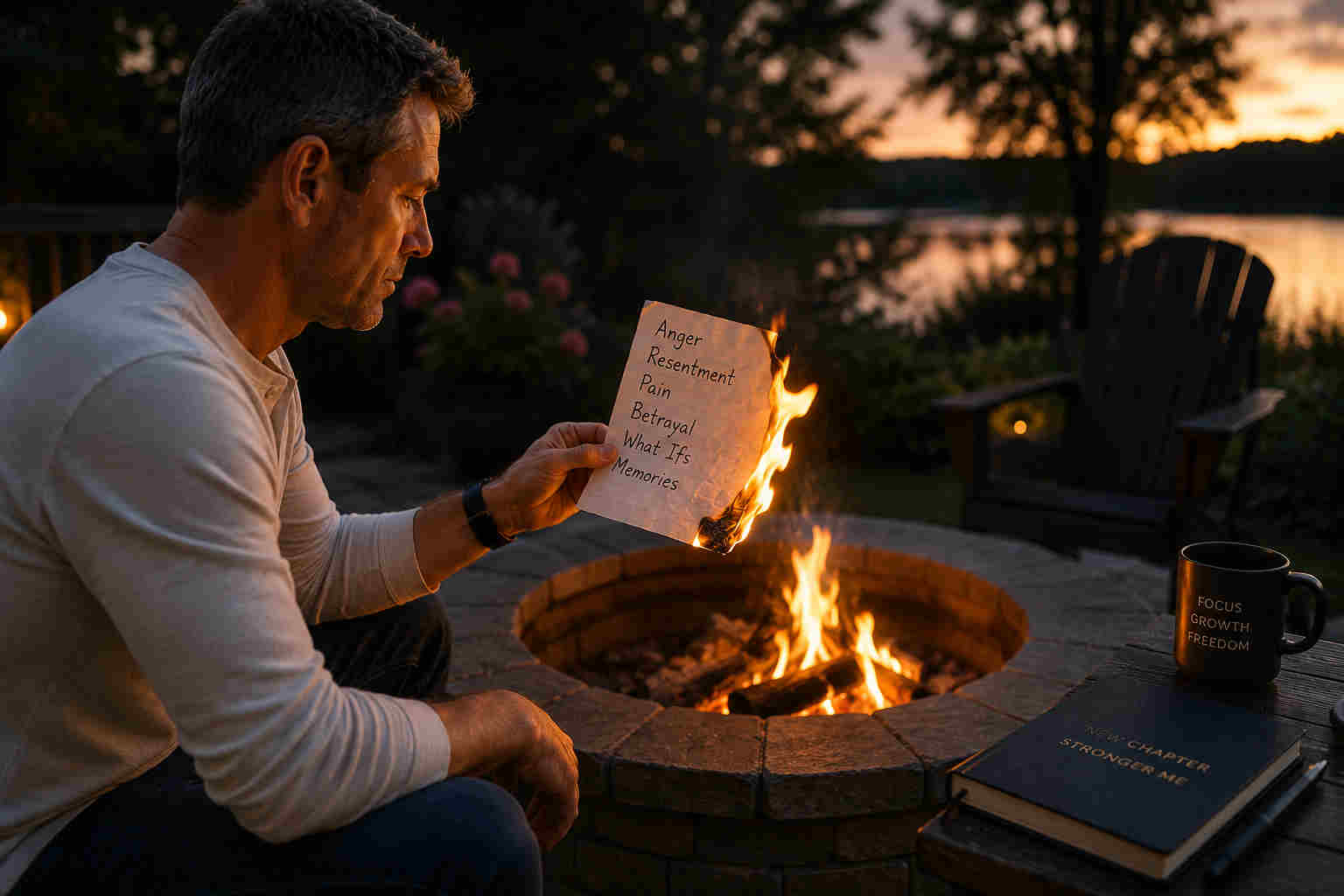
Create your own symbolic ending. Write a private letter you will not send. Include what you appreciated, what hurt, what you regret, what you refuse to carry, and what you are choosing now. Read it once. Then store it, shred it, or safely burn it.
The ritual is not magic. It gives your brain a physical marker that says the review has ended. You are not destroying the history. You are ending the daily obligation to relive it.
Learn To Catch The Mental Replay Early
A regret spiral becomes harder to interrupt after it has gathered emotional momentum. Learn to recognize the first few seconds.
The trigger may be a song, location, photograph, anniversary, social media post, familiar perfume, empty room, or comment from your child. The trigger is not the entire spiral. It is only the doorway.
Use a four-step interruption:
- Name it: “This is a mental replay.”
- Locate the trigger: identify what opened the memory.
- Separate thought from instruction: a memory does not require action.
- Redirect deliberately: choose a present task, conversation, walk, or breathing exercise.
You are not suppressing the memory. You are refusing to let one trigger control the next hour.

Forgiveness Does Not Mean Approval
Some men resist forgiveness because they believe it means declaring the betrayal, neglect, dishonesty, or cruelty acceptable. It does not.
Forgiveness can mean that you stop allowing the injury to collect interest inside your life. You can maintain boundaries, remember what happened, protect yourself, and still decide that resentment will not determine your future behavior.
The same principle applies to self-forgiveness. You do not have to approve of every choice you made. You can acknowledge the damage, make repairs where possible, and refuse to punish yourself forever.
Self-forgiveness without accountability becomes avoidance. Accountability without self-forgiveness becomes a cage. Emotional healing requires both.

Use The Five-Year Question
When regret appears, ask: five years from now, will replaying this memory today improve my life?
The answer is usually no. Then ask the more important question: what action today will my future self appreciate?
Perhaps the answer is exercising, calling your child, paying a bill, scheduling therapy, cleaning your home, going to bed on time, or planning something that gives you a reason to look forward.
The five-year question does not dismiss your pain. It places the current moment inside a larger life. The divorce may remain important without remaining central forever.
Do Not Confuse Missing The Marriage With Needing It Back
You may miss family dinners, shared jokes, holiday traditions, companionship, physical affection, or the feeling of belonging to a household. Missing those experiences does not automatically mean the marriage should have continued.
Your mind often presents the highlights without the context. It compares today's loneliness with yesterday's best moments instead of comparing the entire relationship with the life you are creating now.
A memory can be warm and still belong in the past. A marriage can contain genuine love and still become unhealthy, incompatible, or finished.
Know When Regret Needs Professional Help
Regret is common after divorce, but persistent rumination can become part of depression, anxiety, trauma, or obsessive thought patterns. Consider speaking with a licensed therapist or doctor when the mental replay regularly disrupts sleep, work, parenting, appetite, concentration, or your ability to experience ordinary pleasure.
Seek immediate professional or emergency support if you are thinking about harming yourself or someone else. Getting help is not an admission that you are weak. It is a decision to stop allowing an untreated pattern to control your life.
A Practical Seven-Day Regret Reset
Use this short reset when you feel trapped in repetitive thinking:
- Day One: Write the three regrets you replay most often.
- Day Two: Separate what was yours to control from what was not.
- Day Three: Turn each regret into one specific lesson.
- Day Four: Remove one common trigger you do not need, such as an old social media shortcut.
- Day Five: Schedule one future-focused activity.
- Day Six: Speak with someone trustworthy instead of conducting another private trial.
- Day Seven: Complete a closure ritual and choose the next habit you will practice.
Final Thoughts: Write Tomorrow Instead
Regret proves that the marriage mattered and that you are capable of examining yourself. It does not prove that you must remain mentally married to the past.
You cannot change the argument, recover the missed opportunity, or return with today's wisdom to yesterday's life. You can decide what the experience produces now.
Let it produce clearer boundaries. Let it produce better communication. Let it produce humility, stronger judgment, deeper self-respect, and a life designed with greater intention.
The goal is not to forget. The goal is to remember without being pulled backward.
One day, the memory may still appear, but it will feel more like a chapter you once lived than a room you are still trapped inside. That is what moving forward after divorce looks like—not the disappearance of the past, but the return of your attention to everything still waiting ahead.

Your New Rule
Learn from the memory once. Refuse to live inside it repeatedly.
The past can inform your next chapter without continuing to write it for you.