
Your New Default Body
Divorce Changes More Than Your Relationship Status
Divorce has a strange way of showing up on your body.
Maybe you gained 15 pounds during the final years of your marriage. Maybe you stopped exercising because every spare hour seemed to disappear into work, parenting, arguments, legal appointments, or exhaustion. Maybe you started ordering takeout several nights a week because cooking for yourself felt pointless.
Then one day you look in the mirror and realize you don't just want your old life back.
You want your old body back, too.
Except that may be the wrong goal.
If you're trying to figure out how to lose weight after divorce and keep it off, don't focus on recreating the man you were at 30, 35, or even before you got married. Build a body that works for the life you have now.
That distinction matters.
A temporary diet can make the scale go down. A post-divorce body transformation requires something different: changing the everyday routines that caused you to gain weight in the first place.
And divorce, despite everything difficult about it, gives you an unusual opportunity to do exactly that.
Your Post-Divorce Life Has Different Weight-Gain Triggers
Most weight-loss advice starts with food.
After divorce, it makes more sense to start with your environment.
Look at what changed.
You may now live alone several days or every day of the week. You may have your children only on certain weekends. Your evenings may be much quieter than they used to be. You may be dating again. Your grocery shopping has changed. Your sleep schedule may be different.
Even the times when you're most likely to overeat may have changed.
A married man might have eaten too much at family dinners. A divorced man living alone might eat reasonably all day and then consume half his daily calories between 8:00 p.m. and midnight.
That's why copying someone else's meal plan isn't enough.
You need to identify your post-divorce weight-gain pattern.
For one week, don't try to eat perfectly. Instead, pay attention.
When do you eat when you aren't particularly hungry? Is it after your children go back to their mother's house? Is it while watching television? Do you eat well Monday through Thursday but lose control every weekend? Do you drink more calories than you realize? Does loneliness send you toward food? Does dating mean restaurant meals three nights a week?
Your biggest obstacle may not be carbohydrates, fat, or sugar.
It may be Tuesday night at 9:30.
Find the pattern before trying to fix it.

Don't Start With Your Goal Weight
Suppose you're 235 pounds and want to weigh 195.
Forty pounds sounds significant.
That's exactly why you shouldn't wake up every morning thinking, "I have 40 pounds to lose."
It makes today's success seem insignificant.
Instead, establish your first weight-loss checkpoint.
If you're 235, that might be 225.
Your job isn't to get to 195 yet.
Your job is to become a 225-pound man.
Once you reach that point, you establish another checkpoint.
This approach turns weight loss into a series of achievable phases rather than one long period of deprivation.
It also gives you opportunities to evaluate what's actually working.
Maybe the first 10 pounds come off primarily because you stopped drinking soda and started walking. The next 10 may require better portion control. Later, resistance training and more deliberate meal planning may become increasingly important.
Your strategy can evolve as your body does.
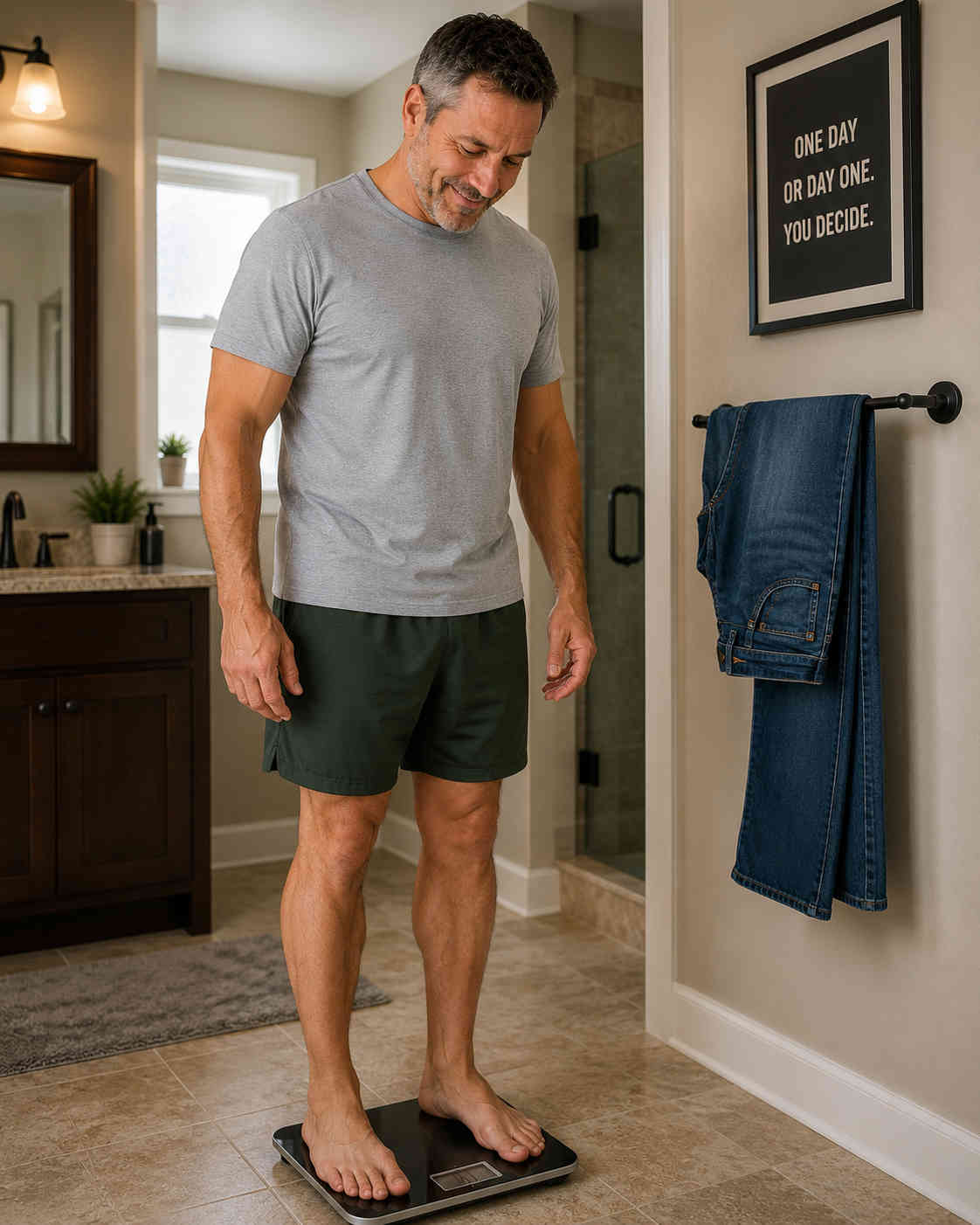
Create A Calorie Deficit Without Making Your Life Miserable
There is no special divorce metabolism.
To lose body fat, you ultimately need to consume less energy than your body uses over time.
But understanding that principle doesn't mean you need to spend the rest of your life weighing lettuce.
The better question is:
Where can you remove calories that you won't miss very much?
This is one of the most useful strategies for sustainable weight loss after divorce.
Imagine two options.
In the first, you eliminate every food you enjoy, survive on tiny portions, and spend every evening thinking about what you can't eat.
In the second, you discover that you're consuming hundreds of unnecessary calories through sweetened drinks, oversized restaurant portions, sauces, alcohol, grazing while watching television, and snacks you don't even particularly enjoy.
The second approach has far more potential to become permanent.
Look for what you might call low-value calories.
These are calories that add relatively little enjoyment or fullness to your day.
- Drinking calories when water or a zero-calorie beverage would have been fine.
- Finishing restaurant fries simply because they're on the plate.
- Eating directly from a bag while watching television.
- Adding large amounts of dressing or sauce without thinking about it.
- Snacking because you're bored rather than hungry.
- Eating your children's leftovers.
- Ordering the largest meal because the price difference is only a few dollars.
You don't have to eliminate every one.
You need enough changes to make your normal day lighter than it used to be.
Build Four Or Five Meals You Can Make Without Thinking
One hidden advantage of being divorced is that you may have more control over what's in your kitchen.
Use it.
You don't need 47 healthy recipes.
You need a handful of meals that are inexpensive, satisfying, reasonably nutritious, and easy enough that you'll actually prepare them when you're tired.
Call them your default meals.
A default dinner could be grilled chicken, a baked potato, and vegetables.
Another might be lean ground beef or turkey in a rice bowl with vegetables and salsa.
Breakfast might be eggs with whole-grain toast and fruit, or Greek yogurt with berries and oats.
Lunch could be a large salad with chicken, a turkey sandwich with fruit, or leftovers from the previous night's dinner.
The exact foods aren't the important part.
Predictability is.
When you come home hungry at 6:30 and have no plan, the easiest food usually wins.
Make healthy food the easy food.
Keep the ingredients for several default meals in your home almost all the time.

Use Protein To Protect The Body You're Trying To Build
Losing weight shouldn't simply mean becoming a smaller version of your current body.
For many divorced men—particularly men in their 40s, 50s, and beyond—the better objective is losing fat while maintaining as much useful muscle as possible.
That means your transformation shouldn't be built entirely around eating less and doing endless cardio.
Make protein-rich foods a regular part of your meals.
Chicken, fish, eggs, lean meat, Greek yogurt, cottage cheese, beans, lentils, and other protein sources can make it easier to construct satisfying meals while supporting your training.
You don't have to turn dinner into a bodybuilding experiment.
A simpler rule is to ask:
Where's the protein?
Ask it at breakfast.
Ask it at lunch.
Ask it at dinner.
That one question can dramatically improve the structure of a diet that previously consisted of coffee for breakfast, fast food for lunch, and whatever happened to be available at night.
Walk Before You Try To Become An Athlete Again
Men often make the same mistake when getting in shape after divorce.
They remember what they could do 20 years ago.
So the first workout becomes a test.
They run too far, lift too much, or spend 90 minutes in the gym.
Two days later everything hurts.
A week later the comeback is over.
Walking doesn't look dramatic enough for the transformation fantasy, which is precisely why it's so useful.
You can recover from it quickly.
You can do it almost anywhere.
It doesn't require a membership.
And you can incorporate it into your existing life.
Start with something repeatable.
Maybe that's a 20-minute walk after dinner.
Maybe you walk during lunch.
Maybe you walk while your son is at soccer practice instead of sitting in the car.
Then gradually increase your total activity.
The goal isn't to prove how hard you can exercise once.
It's to become a man who moves every day.

Add Strength Training Before You Look "Ready" For The Gym
Don't wait until you've lost the weight to start lifting.
Resistance training belongs inside the transformation, not at the end of it.
Two or three sensible strength sessions per week can be enough to establish the habit.
Your routine doesn't have to be complicated.
You can build workouts around basic movement patterns such as pushing, pulling, squatting, hinging, carrying, and core work. Depending on your experience and physical condition, that might involve machines, dumbbells, resistance bands, or body-weight movements.
Start conservatively.
Good training leaves you capable of coming back.
Bad comeback training makes walking downstairs feel like punishment for the next four days.
If you haven't exercised in years or have health limitations, getting appropriate medical guidance before substantially increasing your activity is sensible.

Stop Using Exercise To Pay For Food
There's another trap.
You exercise for 45 minutes and then mentally give yourself permission to eat whatever you want because you "earned it."
That's a poor trade.
Exercise is enormously valuable, but it shouldn't become a financial transaction where every workout deposits calories into an imaginary food account.
Train because you want to become stronger.
Walk because being active is part of your new lifestyle.
Let your eating strategy handle most of the calorie control.
This separation also prevents a bad workout—or a missed workout—from becoming an excuse to abandon your diet.
You aren't trying to burn off last night's pizza.
You're building a different normal.
Design A Different Plan For The Nights You're Alone
For divorced fathers, one of the biggest dietary differences may be the contrast between Dad nights and non-Dad nights.
When your children are with you, dinner may have structure.
When they aren't, structure can disappear.
Those nights need their own plan.
Don't wait until 8:15 p.m., when you're hungry and scrolling through a delivery app, to decide what dinner is.
Know before the evening begins.
This can also be an excellent time to exercise.
The hours that once felt empty can become your transformation window.
Walk. Lift weights. Meal prep. Go grocery shopping. Play a sport. Take a fitness class. Work in the yard.
Do something that creates momentum rather than sitting in the same chair where you've spent the last six months thinking about everything that went wrong.

Be Careful With The "Single Man Weekend"
Friday arrives.
You've eaten well all week.
Then you go out Friday night.
Saturday includes restaurant food, drinks, snacks during a game, and takeout at night.
Sunday becomes a recovery day.
Monday morning, you promise to "start over."
This pattern can erase much of the progress you created during the week.
You don't need to become antisocial.
You need a weekend strategy.
Pick the indulgence that actually matters.
If you're going to a steakhouse, enjoy the steak instead of automatically turning the meal into appetizers, bread, alcohol, an oversized entrée, sides, and dessert.
If you're going out Saturday night, don't treat Saturday morning through Sunday night as one continuous cheat meal.
A social life and weight loss can coexist.
The key is distinguishing an enjoyable meal from an abandoned weekend.

Don't Turn Dating Into A 2,000-Calorie Hobby
Dating after divorce introduces another problem few diet plans discuss.
Dating often revolves around calories.
Dinner.
Drinks.
Coffee.
Dessert.
Another dinner.
Do that several times each week and your new romantic life can quietly work against your body transformation.
Change the format.
Meet for coffee. Walk through a downtown area. Visit a museum. Go to a park. Try an activity.
If dinner is part of the date, eat normally earlier in the day rather than starving yourself in preparation.
And don't order food you don't really want merely because you're nervous.
Your goal isn't to demonstrate dietary discipline to your date.
It's to stop allowing every social event to become a nutritional emergency.
Measure Your Waist, Not Just Your Weight
The bathroom scale is useful, but it's an imperfect storyteller.
Body weight naturally moves around.
A salty meal, hydration, food in your digestive system, and other factors can change the number even when you haven't suddenly gained body fat.
Use several measures of progress.
Track your weight consistently under similar conditions and pay attention to the longer-term trend.
Measure your waist periodically.
Notice how your belt fits.
Notice how your shirts fit around your stomach.
Track your walking distance or pace.
Record your gym performance.
Take an occasional progress photograph.
You may eventually reach a week when the scale barely changes but your waist measurement does.
That's information.
Don't let one morning's number determine whether you think the entire plan is working.

Make Sleep Part Of Your Weight-Loss Strategy
Divorce can destroy sleep.
You stay up too late watching television because the house is quiet.
You scroll on your phone in bed.
You wake up thinking about money, your former spouse, your children, or your future.
Then the next day you're exhausted.
And exhausted men don't usually make their best food decisions.
Sleep is therefore not separate from weight loss after divorce for men.
It's part of the system.
Establish a reasonably consistent bedtime.
Get the television out of the nightly decision-making process.
Stop treating midnight as extra recreational time you deserve because the day was difficult.
Better sleep won't magically melt belly fat, but it can make the behaviors required for weight control considerably easier.
Create A Five-Pound Alarm
Most diets have a finish line.
That's one reason people regain the weight.
Imagine you lose 35 pounds.
You celebrate.
You stop weighing yourself.
Portions slowly grow.
Walking becomes occasional.
Restaurant meals increase.
Six months later, you're afraid to step on the scale because you already know what happened.
Instead, establish your maintenance rules before you reach your goal.
Use A Maintenance Range
Suppose your target is 195 pounds. Your maintenance range might be 193 to 198. Then establish an upper alarm point—perhaps 200.
If your weight trend reaches that point, you don't panic and you don't begin a crash diet. You tighten the system immediately: return to your default meals, reduce restaurant meals, track portions for a week or two, increase your walking, and resume regular weigh-ins.
It's much easier to lose five pounds than 35.
Keep One Piece Of Your "Weight-Loss Life" Forever
This may be the most important part of keeping weight off.
Don't reach your goal and return completely to your old routine.
Something from the weight-loss period has to survive.
Maybe it's your morning walk.
Maybe it's weighing yourself every Saturday.
Maybe it's lifting three days per week.
Maybe it's preparing weekday lunches on Sunday.
Maybe it's no food after 9:00 p.m.
Maybe it's cooking at home Monday through Thursday.
Pick at least one habit that becomes permanent.
Preferably, keep several.
The body you build after divorce requires a lifestyle capable of maintaining it.
Your Transformation Should Make Your Life Bigger, Not Smaller
There is an unhealthy version of post-divorce weight loss.
Every calorie becomes an enemy.
Every restaurant becomes dangerous.
Missing a workout produces guilt.
The scale controls your mood.
You become lighter but your life becomes smaller.
That's not the goal.
The best post-divorce body transformation does the opposite.
You lose enough weight that moving becomes easier.
You become strong enough to do things you had stopped doing.
You sleep better.
You buy clothes because you like how they look rather than because they hide your stomach.
You have more energy with your children.
You become willing to go places you'd been avoiding.
You start seeing your body as something you can improve instead of evidence of years you wish you could redo.
And eventually, weight loss stops being the project.
Living becomes the project.
The Man Who Keeps The Weight Off
If you want to know how to lose weight after divorce and keep it off, don't ask yourself how much punishment you can tolerate for the next 12 weeks.
Ask a different question:
What could I still realistically be doing two years from now?
You can probably still walk.
You can still lift weights a few times per week.
You can still keep better food in your kitchen.
You can still make four or five reliable meals.
You can still watch your portions.
You can still enjoy restaurants without turning every meal into a feast.
You can still monitor your weight and respond when it begins creeping upward.
That's the real transformation.
Not the dramatic before-and-after photograph.
Not the lowest number you can force onto the scale.
Not becoming the man you were before your marriage.
It's becoming a man whose normal habits no longer lead him back to the body he wanted to leave behind.
Your divorce already changed your life.
Now you get to decide what your new life does to your body.

Your Keep-It-Off Rule
Build Habits You Could Still Be Using Two Years From Now
The best post-divorce weight-loss plan is not the strictest one. It is the one that changes your defaults: what you eat on ordinary nights, how often you move, what you do when the house is quiet, and how quickly you respond when old habits start returning.