
Emotional Connection After Divorce
Your Child May Be Feeling More Than He Can Explain
Divorce changes more than where a child sleeps or which parent drives him to school. It changes the emotional map of his family. A child who once knew exactly where Dad would be at breakfast may now see him only on certain days. A bedroom may exist in two houses. Holidays may require a schedule. Money may feel tighter. A parent may begin dating. Even an ordinary question such as “Who is picking me up Friday?” can suddenly carry more emotional weight than it used to.
And yet, when a father asks the most obvious question—“How are you feeling about everything?”—the answer may be one word: “Fine.”
That answer can make you think your child does not want to talk. Often, the real problem is that he does not know how to start. He may be sad and relieved at the same time. He may miss his old home but like parts of the new routine. He may be angry with both parents and afraid that saying so will hurt someone. He may even worry that the divorce was somehow his fault.
If you want to learn how to help your child talk about their feelings after divorce, the goal is not to force an emotional confession. The goal is to build a relationship where honesty feels safe enough to happen on its own.

Your Child May Be Talking Without Actually Talking
One of the most useful things a divorced father can learn is that behavior is often communication. Your son may never say, “Switching houses every Sunday makes me feel like I do not really belong anywhere.” Instead, he complains about packing. Your daughter may never say, “I am afraid you will eventually have a new family and not need me.” Instead, she becomes clingy when the weekend ends.
A child who suddenly becomes angry about something insignificant may be carrying a much larger feeling underneath it. That does not mean every bad mood needs to become a psychological investigation. It means you should occasionally look behind the behavior before reacting to it.
If your child snaps because you bought the wrong cereal, ask yourself what else is happening. Is tomorrow a transition day? Did you mention dating? Is there a school event where both parents will be present? Did a schedule change disappoint him? Did he overhear an adult conversation that he only partially understands?
When you respond only to the surface behavior, you may discipline the signal without ever discovering the message. When you stay observant, you create room for the real issue to emerge.
Stop Making “How Do You Feel?” The Main Question
Adults understand what “How do you feel?” means. Children often do not. It is an enormous question. Imagine someone asking you to summarize how you feel about your entire divorce in one sentence. Angry? Relieved? Lonely? Hopeful? Rejected? Embarrassed? All of them?
Children can experience the same emotional traffic jam. Instead of asking for a complete emotional summary, ask about something specific.
Try Smaller Questions
“What is the hardest part about switching houses?”
“Is Sunday night harder than Friday night?”
“What is one thing you wish was different at Dad's house?”
“What is something about the divorce that adults do not seem to understand?”
Specific questions give your child somewhere to begin. You do not need his entire emotional autobiography tonight. One honest sentence is enough. When that sentence is handled well, another may eventually follow.
The Best Conversations Often Happen When You Are Not Looking At Each Other
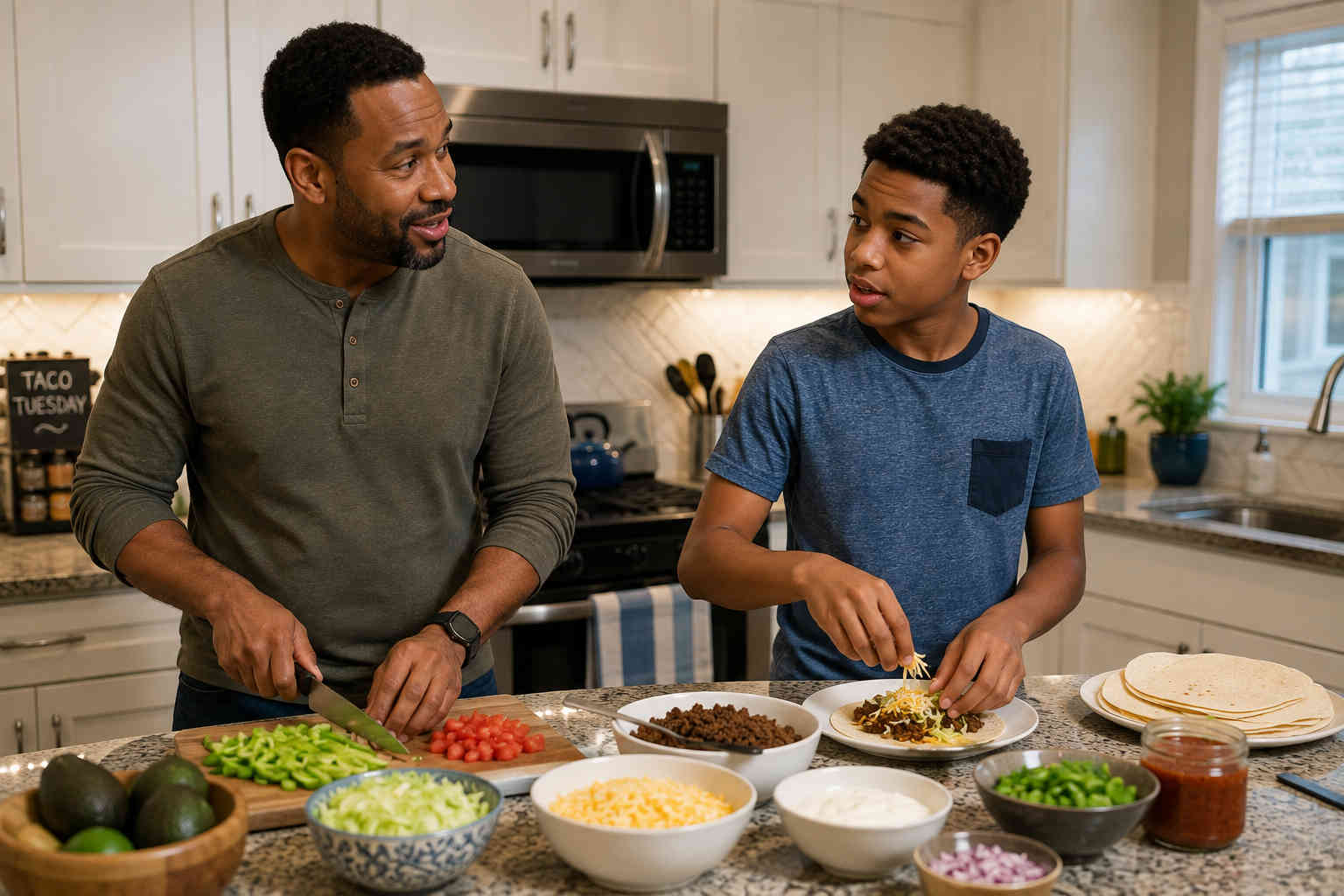
There is a reason important father-child conversations often happen in cars, on walks, or while doing something with your hands. There is less pressure. Nobody is sitting across a table waiting for an emotional performance.
Use that. If you are focused on helping children express feelings after divorce, do not automatically schedule a serious conversation. Create opportunities where talking can happen naturally. Walk the dog. Cook dinner. Shoot baskets. Fold laundry. Work in the garage. Drive somewhere together.
Then introduce the subject lightly. “You have been going back and forth between houses for a while now. What part of it do you like least?” Then keep walking. Do not immediately stare at your child like a detective who just received a confession.
Silence is not necessarily rejection. Sometimes your child is deciding whether the question is safe to answer.

Give Your Child Permission To Say Something You Will Not Like
This is where many well-intentioned fathers accidentally close the emotional door. Suppose your child says, “I like Mom's house better.” Your first instinct may be to defend yourself. Why? What does she have that I do not? I have done everything I can to make this place comfortable.
Now your child has learned something important: honesty hurts Dad.
Next time, “Both houses are fine” becomes the safer answer.
Instead, become curious. “Okay. What feels better there?” Maybe the answer has nothing to do with loving one parent more. His clothes may be there. His friends may live nearby. His bedroom may feel more familiar. The school bus may stop outside. Understanding the answer gives you useful information.
The same principle applies if your child says, “I hate coming here,” “I wish you and Mom were still married,” “Mom understands me better,” or “I do not like your girlfriend.” Your first job is not to defend yourself. Your first job is showing your child that he can tell Dad difficult things and Dad can handle them.

Do Not Turn Their Feelings Into A Trial About Your Ex
Your child says, “Mom is always angry.” Be careful. You may have opinions about that subject. Your child does not need them.
Try, “What happens when you feel like she is angry?” Notice the difference. You are exploring your child's experience rather than building a case against your former spouse.
If every complaint about Mom produces an enthusiastic response from Dad, your child may eventually realize that criticizing Mom wins your approval. Now you are no longer hearing your child's feelings. You are accidentally rewarding an alliance.
Keep bringing the conversation back to the child. “What was that like for you?” “What did you need when that happened?” “What would have helped?” Those are emotional questions. “Why does your mother always do that?” is not.
Teach Feelings Vocabulary Instead Of Expecting Your Child To Already Have It
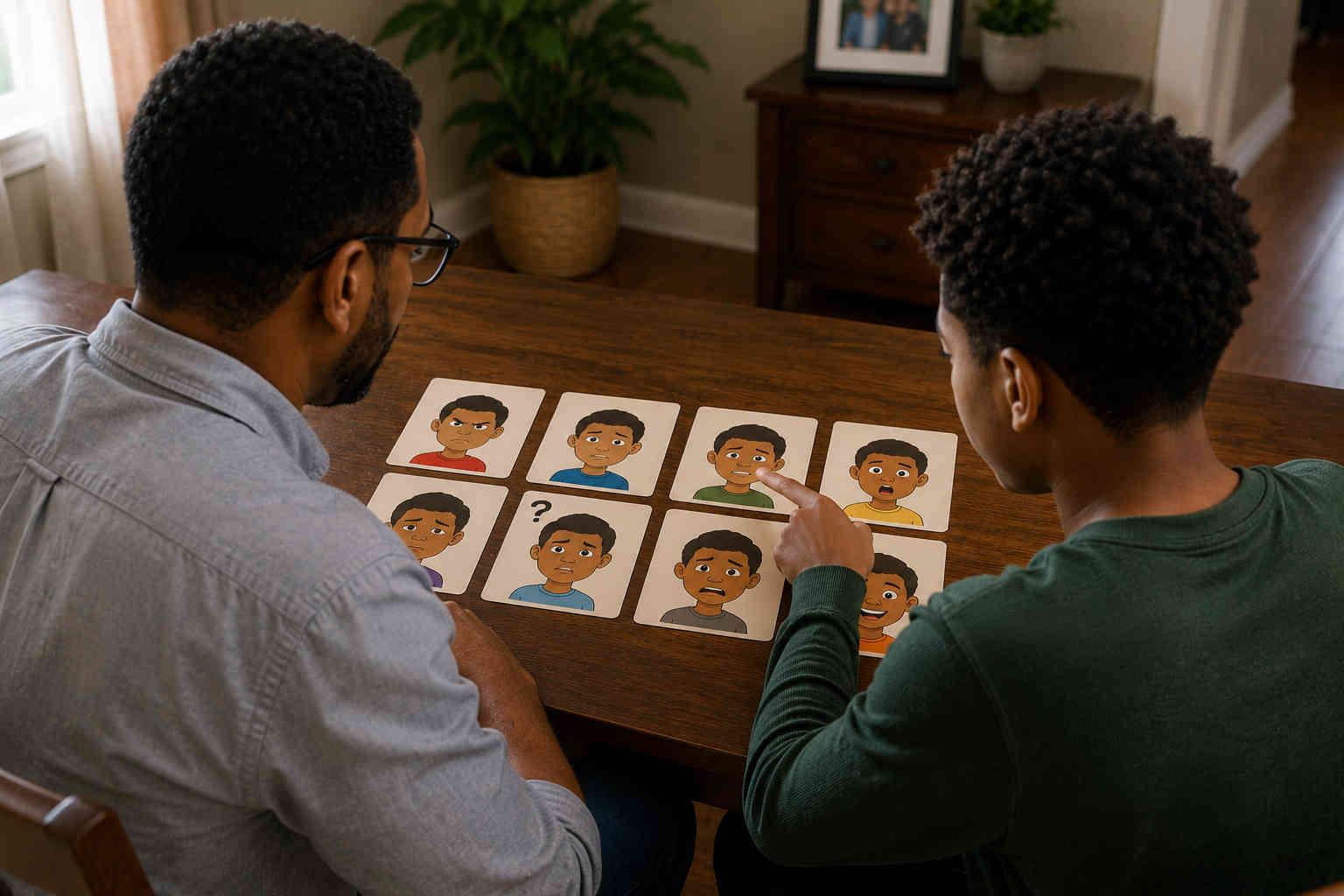
A child cannot easily describe an emotion he does not know how to name. Many children operate with a small emotional vocabulary: mad, sad, happy, scared, fine. But “mad” can mean frustrated, rejected, jealous, embarrassed, powerless, ignored, confused, or lonely.
You can teach this naturally. If your son says, “I hate having two houses,” you might respond, “Does it feel more frustrating, or does it sometimes feel lonely?” You are not telling him what he feels. You are offering vocabulary. He may say, “Not lonely. Just annoying.” That is useful too. Now you know.
Use The “Two Things Can Be True” Rule
Divorce creates emotional contradictions. Children need permission to have them. A child can love Mom and be angry with her. He can enjoy Dad's house and miss the old home. He can like Dad's new girlfriend and still wish his parents were together. He can enjoy two Christmas celebrations and hate that the family is divided.
Teach this directly: two things can be true at the same time.
That sentence removes pressure to choose the “correct” emotion. Your child does not need to decide whether the divorce was good or bad. He needs room to experience what it actually feels like.

Do Not Correct A Feeling Just Because The Facts Are Wrong
Suppose your son says, “You do not want me around anymore.” You know that is completely false. Your instinct may be to say, “That is ridiculous. Of course I want you around.” Factually correct. Emotionally ineffective.
Try this instead: “Something is making you feel like I do not want you around. Tell me about that.” Now you may discover that you canceled two weekends because of work. To you, those were scheduling problems. To him, they became evidence.
You can correct the interpretation later. First understand the emotion. The same approach works when a child says, “You care more about your girlfriend,” “Mom does not need us anymore,” or “You chose the divorce instead of us.” Feelings are not courtroom testimony. You do not have to agree with the conclusion to take the emotion seriously.
Talk About The Question Children Are Sometimes Afraid To Ask: “Was It My Fault?”
Children can privately connect events in ways adults never anticipate. Maybe your child remembers hearing you argue about discipline. Maybe he remembers getting into trouble shortly before you moved out. A child can quietly construct a story: “They fought about me. Then Dad left. Maybe I caused this.”
That is why reassurance should not happen only once. Children need to hear repeatedly that the divorce was an adult decision, they did not cause it, and they could not have prevented it.
Do not assume your child already understands because you explained it six months ago. Children revisit divorce as they mature. A seven-year-old understands it differently at ten. The ten-year-old understands it differently at fifteen. The conversation evolves with them.

Share Some Of Your Feelings—But Do Not Make Your Child Carry Them
Children benefit from seeing that men have emotions. A father does not need to pretend the divorce was emotionally effortless. You can say, “I miss some things about our old family life too,” or, “Sometimes the house feels quiet when you are not here.” This teaches your child that sadness is not weakness and feelings do not have to be hidden.
But there is an important boundary. Your child should never become your therapist. Avoid statements that transfer adult burdens: “Your mother destroyed our family,” “I do not know what I will do without her,” or “I cannot afford this because of what she is doing to me.”
Model vulnerability without handing your child the responsibility for managing your pain.
Create A Regular Emotional Check-In That Does Not Feel Like Therapy
Instead of waiting until something goes wrong, create a small ritual. Maybe during Saturday breakfast you occasionally ask, “Anything going on lately that Dad should know about?” Sometimes the answer will be no. Accept it. The ritual still matters because you are communicating that the door is open.
Another useful method is a simple three-question check-in: What was good this week? What was difficult? Anything you wish were different?
That is enough. Do not turn every parenting weekend into an emotional interview. Children need ordinary life too. They need jokes, homework, basketball, video games, pancakes, boring errands, and quiet time. Emotional security is often built through hundreds of normal moments rather than one dramatic conversation.
Pay Attention To What Happens After Your Child Opens Up
Getting your child to talk is not the finish line. What happens afterward determines whether he will do it again.
Suppose your child admits, “I hate feeling like a visitor here.” You listen calmly. Good. But if nothing changes, the message may become: Dad hears me, but nothing happens.
Look for one reasonable action you can take. Give him a permanent drawer so he is not living out of a backpack. Keep toiletries at both homes. Leave some favorite clothes there. Give him a shelf for his own things. Adjust the transition routine if he tells you he needs time to decompress after arriving.

Small changes tell your child: Dad did not just hear me. Dad listened. That makes future honesty more likely.
Know When Silence May Mean Your Child Needs More Help
Not every child will want to discuss divorce with Dad. That does not automatically mean something is wrong. Your child may prefer talking with Mom, a grandparent, coach, teacher, counselor, or another trusted adult.
Do not make emotional openness with you the test of whether your child is coping well. What matters is whether he has healthy ways to process what he is experiencing.
However, persistent changes deserve attention. Watch for significant withdrawal, continuing sleep problems, major academic changes, loss of interest in normal activities, intense anxiety, ongoing behavior problems, or emotional reactions that increasingly interfere with everyday life. If you are concerned, a pediatrician or qualified child mental-health professional can help you decide whether additional support would be useful.
Your Goal Is Not To Get Your Child To Talk—It Is To Become Someone They Can Talk To
There is an important difference. If your goal is getting information, you will ask more questions. If your goal is building emotional safety, you will become a better listener.
You will tolerate uncomfortable answers. You will stop trying to fix every feeling. You will avoid turning conversations into discussions about your ex. You will apologize when you are wrong. You will keep private information private. You will let silence exist. And you will show your child, repeatedly, that difficult emotions do not threaten your relationship.
One evening your child may tell you almost nothing. Three weeks later, while you are doing something ordinary together, he may suddenly say, “Dad, can I tell you something?” That moment did not come out of nowhere. It was built during all the earlier moments when your child discovered that talking to you was safe.

The Conversation Does Not End When The Divorce Is Final
A legal divorce has an ending date. A child's adjustment does not. New emotional questions can appear years later: the first Christmas with separate parents, Dad's first serious relationship, Mom's remarriage, a new sibling, graduation, or even the child's own future marriage.
That is why helping kids cope with divorce emotionally is not about having one perfect talk. It is about creating a family culture where feelings can be discussed without punishment, embarrassment, or loyalty tests.
Your child does not need you to have every answer. He needs to know that he can tell Dad the truth, he does not have to protect Dad from his feelings, he is allowed to love both parents, he did not cause the divorce, and whatever he is feeling today will not make Dad disappear tomorrow.
The Emotional Open Door
Make Honesty Safer Than Silence
Ask smaller questions. Notice behavior. Listen without defending yourself. Give your child better words for complicated feelings. Then prove through your actions that what he tells you matters. That is how emotional trust is built after divorce.